
In 2025, a team of experts from UK Centre for Ecology & Hydrology, Lancaster University, and Small World Consulting (SWC) launched their transdisciplinary project, ‘Reimagining digital research infrastructure in environmental science for a sustainable future’. Our goal: looking at the growing environmental costs of digital research infrastructure (DRI) and gains for environmental science.
Given the established practice of large-scale computational model use, our first of three case studies has focused on modelling – and specifically the Joint UK Land Environment Simulator (JULES) as an example of this. We have sought to understand JULES as it is currently used from the literature, and interviewed its users and developers to gain from their knowledge and experience. How does modelling occur in practice? What benefits does it offer? And how does JULES connect with other forms of DRI (e.g., driving growth in data, or demand for high performance computing (HPC))? We aim to uncover forms of possible technical and cultural ‘waste’ – offering opportunities for sustainable change.
Having interviewed 17 JULES users and developers, the team is now expanding their interviewing to infrastructural providers and other associated individuals (e.g., land managers of that infrastructure). If you are working in this domain, please contact Dr Carolynne Lord (CarLor@ceh.ac.uk) and Dr Marcia Tavares Smith (marcia.smith@lancaster.ac.uk).
As process model emulation using AI is gaining traction, we are supporting our understanding of JULES with a literature review which specifically examines AI model emulation. This is important as it is seen both as an opportunity to reduce the computational demands of modelling, and simultaneously as an area for increased growth of compute over time due to efficiencies often leading to more demand (i.e., ‘rebound effects’).
To read more about the scoping review, you can find the review protocol on data-driven surrogate modelling techniques for land surface models here: https://doi.org/10.17605/OSF.IO/H8GYU
To explore the costs, the team have started construction of a systems complete carbon accounting model to enable DRI scenarios to be modelled, with and without AI, and from laptop to HPC and cloud scale. This leverages state of the art models and SWC’s deep expertise in this area. If this challenge interests you, then we invite you to reach out to us.
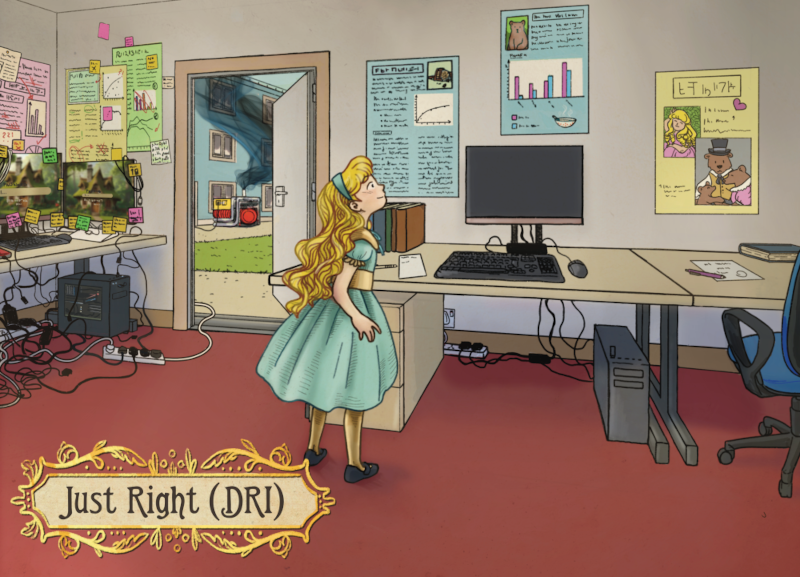
The project aims to intervene, as much as understand, so the team have been exploring the concept of ‘sufficient’ DRI – i.e., how much and what DRI is ‘enough’ in answering different scientific questions – working to achieve a balance between DRI’s costs and its gains for a more sustainable future. Workshops have been trialled in UKCEH’s Net Zero Week to design sufficient DRI; these will be built upon and extended next year to broader DRI communities. As challenging the status quo will require difficult conversations, a collaboration with artist Véronique Heijnsbroek has sought to develop an illustration based on the fairytale Goldilocks and the Three Bears. This work looks to inspire discussion around sufficiency and the ‘just right’ balance it implies, working towards the development of future sufficiency policies and actions for a more sustainable DRI future. A publication submission is also in prep to explain sufficiency in the context of DRI.
As well as the project work, the team have shared insights on sustainable digital technology to a broad range of stakeholders and community groups, including presentations to the British Antarctic Survey (BAS), the Network for sustainable Digital Research Infrastructure Vision and Expertise (NetDRIVE) community, the IRIS network, the Trade and Public Policy (TaPP) network, the Digital Innovation & Circular Economy (DICE) Network+, and others, as well as briefings to UK Government and media outlets.
This work is supported by the UK Research and Innovation Engineering and Physical Sciences Research Council [grant number: EP/Z533774/1]. For more information on the project or to discuss opportunities to collaborate, please contact Dr Kelly Widdicks (Principal Investigator) at KelWid@ceh.ac.uk.