
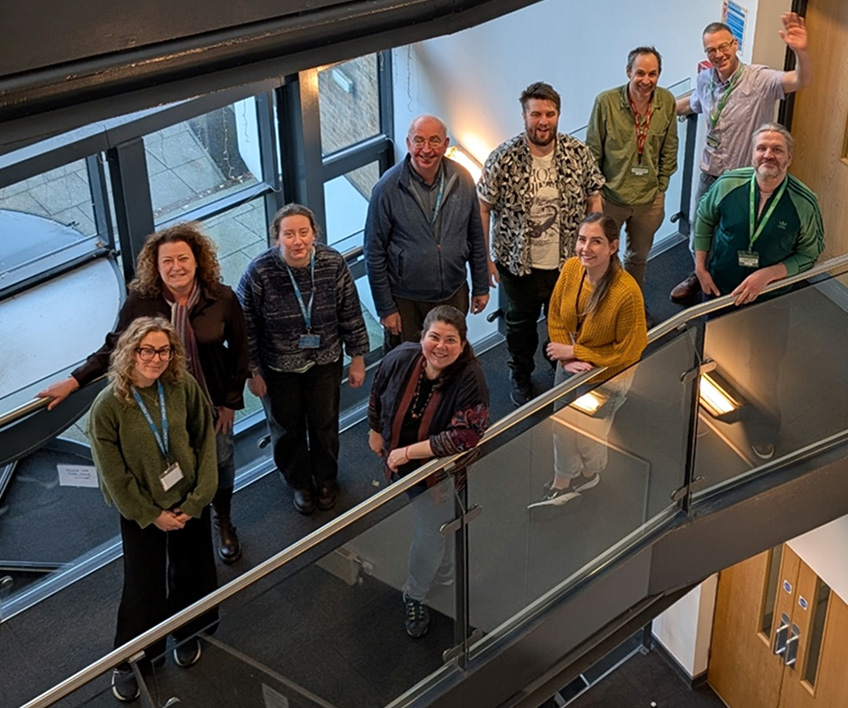
Dr Kelly Widdicks is the Lead for Digital Innovation in the Digital Research group at UKCEH. Her research interests focus on the responsible design and development of digital research infrastructure for environmental science, taking a systems thinking approach that considers the wider societal and environmental impacts that digital technology can create. She is Principal Investigator for this EPSRC project focused on sustainable digital research infrastructure for environmental science. Kelly also leads large projects involving co-design research activities to ensure that digital research infrastructure meets a variety of stakeholder needs; this includes co-leading the digital integration work package for the National Capability for UK Challenges (NC-UK) programme.
Dr Carolynne Lord is a Senior Digital Sociologist who works in the Digital Research group at UKCEH. Her research explores the use and provision of technologies and infrastructures making use of sociological concepts to better understand the roles that technologies take in social practices. More recently, her work has focused on digital research infrastructures and how these shape current and future scientific configurations – with a particular focus on the sustainability implications of (not) using these. She also has a passion for developing methods that help researchers communicate their scientific insights in ways that engage diverse stakeholders and communities.
Prof Gordon Blair is Head of Environmental Digital Strategy at UKCEH, and Co-Director of the Centre of Excellence in Environmental Data Science (CEEDS), a joint initiative between UKCEH and Lancaster University. His current research interests focus on the role of digital technology in supporting environmental science, including the end-to-end pathway from data acquisition through making sense of this data to offering scientific insights and informing policy. He is particularly interested in the future of Digital Research Infrastructure (DRI) and how such infrastructure can support a new kind of science that is more open, collaborative and integrative whilst also being sustainable.
Dr Lily Gouldsbrough is a data scientist in the Digital Research group at UKCEH, researching and developing data science methods for environmental applications. Her research spans statistical modelling, machine learning, and AI, with a keen focus on enhancing data discoverability and integrating diverse environmental datasets. Her research interests range from predictive modelling and knowledge graphs to ML-based model emulation. She is particularly interested in how AI can support sustainable digital research infrastructures and improve scientific understanding of environmental systems while ensuring responsible and effective AI use.
Dr Joe Marsh Rossney is a Research Software Engineer at UKCEH, having recently finished a PhD focused on generative machine learning techniques in particle physics. He has broad research interests, most recently in advancing the state of environmental modelling, and strongly believes that good software practices facilitate better research.
Marika Glasby is a Project Coordinator working within Digital Research at UKCEH. She is providing Project Management support for the Sustainable DRI project and assists in the coordination and support of projects across the Digital Research group. She has previous experience as a Data Centre Technician for the Environmental Information Data Centre, assisting in the long-term management of research data and providing NERC Grant support.
Dr Kirsty Blair is a Data and Digital Social Scientist in the Digital Research group at UKCEH. Her research focuses on improving stakeholder engagement with environmental data and digital services, as well as supporting the development of sustainable and accessible digital research infrastructure. She recently completed her PhD at the University of Edinburgh, where she explored pathways towards more sustainable livestock futures using systems thinking and futures‑oriented approaches, alongside computational methods for analysing discursive trends. In addition to mixed‑methods social science research, Kirsty has a background in research communications and a strong interest in creative approaches to engaging people around environmental challenges.
Dr Taylor Butler-Eldridge is an interdisciplinary social scientist in the Digital Research group at UKCEH, with a background in digital design, outdoor and environmental education, and qualitative research. His research explores environmental health, pollution, human well-being, social equity, and creative communication, often informed by relational approaches. At UKCEH, Taylor's work has included widening access to environmental science by developing digital research infrastructure that better supports non-expert and community users.
Dr Kate Wright is a Data Steward based in the Digital Research Group at UKCEH. She provides data management support within UKCEH and to NERC grant holders and also supports the deposit of environmental data into the Environmental Information Data Centre (EIDC). Alongside this, Kate carries out interdisciplinary research, combining her interest in environmental research with social science research methods. Kate recently completed a PhD which used qualitative research techniques to understand how the different stakeholders within environmental data science navigate uncertainty in order to make decisions.
Prof Adrian Friday is Professor of Computing and Sustainability at Lancaster University. His interdisciplinary projects focus on understanding how digital systems impact energy and carbon footprint, including: energy use in the home; thermal comfort; sustainable food choices; sustainable transport and last-mile logistics; and understanding business energy and context data using time-series statistical and ML techniques. He is advisor to the leading Ubicomp journal, IMWUT; and Royal Society "Digital Technology and the Planet" working group on policy for ICT toward sustainable digital society.
Dr Michael Stead is Lecturer in Sustainable Design Futures, Undergraduate Admissions Tutor and Research Impact Lead at Lancaster University’s School of Design and Imagination Design Research Lab. His EPSRC, AHRC and ESRC funded practice-based research explores the environmental, social, and economic opportunities and challenges emerging digital technologies like Internet of Things and AI, pose for achieving climate goals like Net Zero and Circular Economies. Advancing approaches including Speculative Design, More-than-Human Design and Participatory Design, he is developing innovative tools and strategies with community partners, policymakers, and wider industry, to support real-world adoption of sustainable and equitable technological practices and infrastructures across society.
Dr Alison Stowell is a Senior Lecturer in the Department of Organisation, Work and Technology, Lancaster University, UK. She is a qualitative social science researcher, and her research focuses on societal, organisational and management responses to waste. She has collaborated and led on numerous interdisciplinary projects on e-waste organisation; e-waste flows and fates; organic electronics benefits, barriers, and opportunities; plastic and circular economy, and littering. She co-led the Plastic Packaging in People’s Lives Project and leads on the spin-off projects. She is well equipped to speak across disciplines and has been published in management and organisation, environmental studies, material science and ethnography journals and she has co-edited, co-authored books and book chapters.
Dr Marcia Smith is a design researcher and designer with experience in participatory approaches. She is a Senior Research Associate at the School of Computing and Communications conducting research on the environmental impacts of digital technologies. She is interested in transdisciplinary research and systemic design (where systems thinking meets design thinking), and in exploring systemic design methods such as gigamapping to bridge disciplinary gaps, collaborate in building knowledge and visualise complexity.
Dr Oliver Bates is a design researcher, game designer, coder, and recovering data scientist. He is a Research Fellow in the School of Computing and Communications. Oliver’s work crosses many disciplines and topics, but he’s at his best when working in the context of climate futures and just work. His research reflects his passion for sustainability, systemic thinking, alternative futures, speculation, having fun, talking to people, and creativity. In his free moments he tries to host conversations that matter, play and have fun, and consciously live in the space between a dying system and what comes next.
Prof Mike Berners-Lee consults, thinks, writes and researches on sustainability and responses to 21st century problems. He is the author of acclaimed books, including A Climate of Truth, There is No Planet B and How Bad Are Bananas? The carbon footprint of everything. As founder and director of Small World Consulting he helps organisations of all sizes and sectors to address the challenges of the Anthropocene. He is a professor at Lancaster University, where his research includes supply chain carbon modelling, sustainable food systems and the environmental impact of ICT. He has made numerous speaking, radio and television broadcast appearances to promote public awareness of sustainability and climate change issues. In February 2025, he was awarded the Planet Earth Award by the Alliance of World Scientists for his work on seeking solutions to environmental challenges.
Dr Tom Higgs is a consultant at Small World Consulting and honorary researcher at Lancaster University. His background was in physics before switching fields to climate change and sustainability. He works with commercial and public sector clients helping them understand their carbon footprints and how to reduce their environmental impact, particularly in the land use sector. He also contributes to Small World’s ongoing communication, engagement and research activities.