24.08.2026

Scientists have been carrying out water sampling at Lough Neagh in Northern Ireland as part of a project to investigate sources of pollutants in the lake, in order to support its restoration. 

The CLEAR-Neagh project, led by the UK Centre for Ecology & Hydrology, is using advanced scientific methods to trace pollution across the catchment including tributaries, inlets and the shoreline. Sources of excess nutrients include run-off from farms, human wastewater from treatment plants and septic tanks, as well as industry. 

The project will also provide a better understanding of the potential threats such as antimicrobial resistance (AMR) and invasive species that can pose risks to ecosystems, livestock and human health. 

Lough Neagh, which is the UK’s largest freshwater lake in terms of surface area, is the source of around 40 per cent of the country's drinking water. It also supports agriculture, fisheries and is an internationally important wetland for wildlife. Algal blooms in recent years have highlighted the urgent need for tools to better identify the sources and movement of pollution across the catchment.  

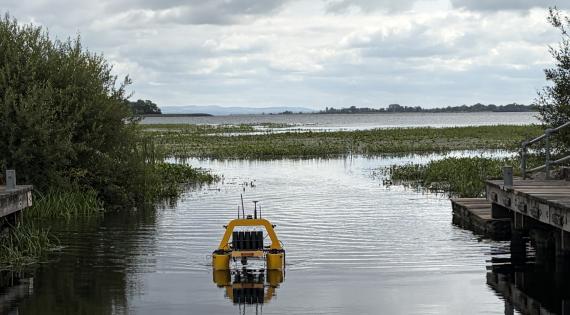
The new project, which involves UKCEH, Biota Trace and the Lough Neagh Partnership, is taking water samples from more than 60 locations – 30 around the lough and the other half in rivers that feed into it. These samples are collected and filtered using technology developed by Biota Trace, which also provides a remote-controlled boat for points further out into the water.  

The exercise is being done at the same locations six times over the course of the 18-month project. 
Image
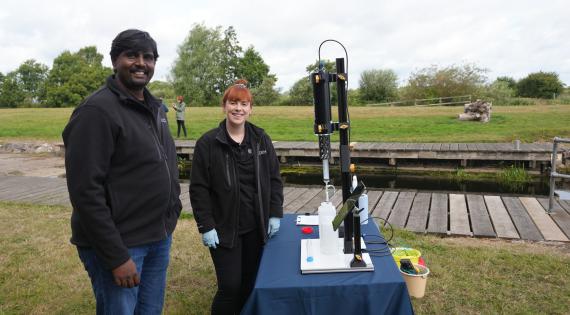
Susheel Bhanu Busi and Elysha Duke, UKCEH.

Susheel Bhanu Busi and Elysha Duke of UKCEH at Lough Neagh.

Image
Biota Trace remote-controlled boat.

Biota Trace's remote-controlled boat collects off-shore water samples.

The researchers will use environmental DNA (eDNA) techniques and other advanced microbial analysis to identify traces of faecal matter and whether these originate from humans, cattle, birds, pigs or dogs, the relative contribution of these individual sources, as well as pollution hotspots. They are also investigating whether microbes are developing resistance to medicines in the lough and linked rivers 

Dr Susheel Bhanu Busi, Head of Molecular Ecology at UKCEH who is leading the project, said: “We are very grateful to local people for supporting our research, especially those who have allowed us onto their land, including some gardens, in order to take samples.” 

“Lough Neagh is hugely important to the community – for livelihoods, recreation and wildlife – and we are keen to do what we can to provide decision-makers with the scientific evidence needed to take action to restore it.” 

The research team expects to report its results towards the end of next year. The information will be available in a user-friendly format via an online science platform which will help the Lough Neagh Partnership and other stakeholders see patterns, trends and risks.  

Further information 

The CLEAR-Neagh project (Catchment-Level Environmental AMR & eDNA Reconnaissance for Lough Neagh) is being funded by the Natural Environment Research Council (NERC) and the Department of Agriculture, Environment and Rural Affairs (DAERA).  

It is part of the £9m UK Freshwater Quality Programme, which is investigating how pollution affects water quality in lakes and rivers, which is led by the University of Leeds and funded by NERC and Defra. 

2023 - Present    Soil Molecular Ecologist, UKCEH Wallingford, UK. 
2019 - 2023        Research and Development Specialist, University of Luxembourg, LU. 
2013 - 2018        Graduate Research Associate, University of Missouri, USA. 
2009 - 2013        Research Scientist, Imagilin Technology LLC., USA. 

Employment

2020 - present: Molecular Biologist, UKCEH.

2016 - 2021: PhD student, UKCEH and University of Exeter. 


Employment history

  • PhD student, Paisley College of Technology, 1976-1979
  • Royal Society funded post doctoral reseach associate, Intitute of Limnology, Austria, 1979-1980
  • Freshwater ecologist, CEH, 1980 to present

Editing, lecturing and memberships of scientific organising committees