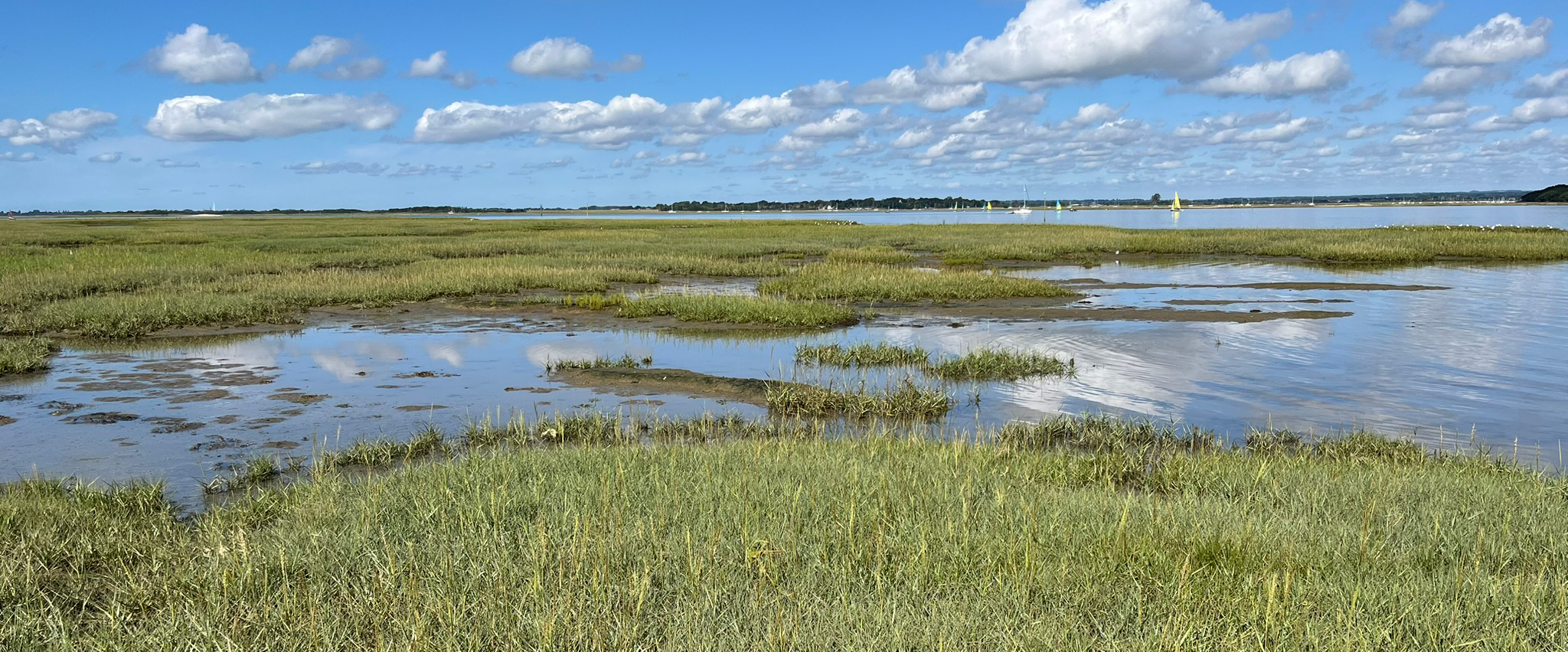
Saltmarshes play a significant role in mitigating and adapting to climate change. We take a look at the value of these coastal wetlands and how UKCEH research is helping to build the scientific case for recognising these ‘blue carbon’ habitats in the UK’s Greenhouse Gas (GHG) Inventory. We also highlight a UKCEH-developed interactive UK Saltmarsh Carbon Database webtool, designed to visualise UK-relevant measurements of carbon accumulation and GHG fluxes.
Why saltmarshes are missing from the UK GHG Inventory
Saltmarshes are not currently included in the Land Use, Land Use Change and Forestry (LULUCF) sector of the UK’s GHG Inventory, which is the UK’s official record of progress towards national and international climate targets. Only three countries, Australia, the USA and Malta, currently report emissions and removals from saltmarsh habitats, largely due to limited data.
To address this gap, UKCEH is leading multiple research projects to build the evidence base needed for future reporting. These efforts are summarised on the UKCEH Saltmarsh GHG Inventory webpage.
The quiet climate heroes
Saltmarsh plants absorb carbon dioxide directly from the atmosphere as they grow. Over time, this carbon becomes locked away in the sediments beneath them. These habitats also trap carbon delivered by creeks and tides, creating long-term carbon stores that can persist for centuries. Alongside this climate benefit, saltmarshes provide vital habitat for wildlife and act as natural buffers that reduce coastal flood risk.
New Evidence: saltmarshes as significant carbon sinks
UKCEH research for Defra, published in December 2025, outlines new evidence on how much carbon UK saltmarshes can store helping to grow the evidence base for their inclusion in the UK’s Greenhouse Gas Inventory (GHGI).
UKCEH’s assessment of carbon accumulation and greenhouse gas fluxes has produced the first emission factors for saltmarshes in northern temperate Europe. The findings are striking:
Natural UK saltmarshes could provide a net carbon sink of 6.5 tonnes CO₂ equivalent per hectare per year — a rate comparable to other major blue carbon ecosystems such as mangroves and seagrasses.
Restored saltmarshes show slightly higher carbon burial rates, although more research is needed to understand how long this enhanced storage continues after restoration.
These insights offer strong scientific support for recognising saltmarshes within national climate accounting.
A new open access tool: the UK Saltmarsh Carbon Database
To make this growing evidence base accessible, UKCEH has developed an interactive, open access UK Saltmarsh Carbon Database Webtool. The platform allows users to:
- Visualise measurements of carbon accumulation and GHG fluxes
- Explore and download datasets
- Contribute new data for future updates to emission factors
This “living database” is designed to evolve as new research emerges, supporting scientists, policymakers and restoration practitioners.
Led by UKCEH, the project is funded by Defra through the Environment Agency with the webtool being maintained by NC-UK.
UKCEH scientist Hannah Clilverd comments, “This research provides a clearer picture of how important UK saltmarshes are for carbon accumulation, which strengthens the case for their protection and careful management.”
Looking ahead: The Saltmarsh Flux Tower Network
Future updates to the database will be informed by the Saltmarsh Flux Tower Network — seven monitoring sites across the UK where carbon dioxide fluxes are measured continuously at a landscape scale using Eddy Covariance technology. These long-term observations will provide unprecedented insight into how saltmarshes function as carbon stores over multiple years .
The UKCEH scientists working on this are: Annette Burden, Hannah Clilverd, Beth Raine, Shona Ferguson, Stefanie Carter, Lindsay Banin, Angus Garbutt and Gwen Buys.
Further information
UKCEH blue carbon and saltmarsh research
Counting the Earth podcast:
Secrets of the Saltmarsh: 450