Rivers across the world in 2025 had one of their driest years in recent decades, reflecting an ongoing trend that has serious future implications for people and economies. That is according to the World Meteorological Organization (WMO) in its newly published State of Global Water Resources, report, a comprehensive science-based assessment of the hydrological cycle for 2025.
Produced annually since 2021, it draws on data and expertise from national meteorological and hydrological institutions worldwide, including the UK Centre for Ecology & Hydrology
The latest edition of the report says:
-
2025 was the third driest year for river discharge in 35 years.
-
The past seven years have seen abnormal river flows – either very low or very high – in a clear majority of catchments globally.
-
Terrestrial water storage – the total amount stored in groundwater, lakes and rivers, soil moisture, vegetation and ice and snow – has been in decline for the past 10 years.
-
There was widespread glacier loss across all regions for the fourth consecutive year.
-
Asia and Africa are the regions most affected by severe floods and droughts, though data gaps remain in hard-hit areas.
The report estimates that in total, between 2023 and 2025, cumulative global glacier mass loss was 1,400 gigatonnes of water – enough to fill about 560 million Olympic-sized swimming pools. Rapid, rather than gradual, melting leads to floods and later a lack of available water for communities.
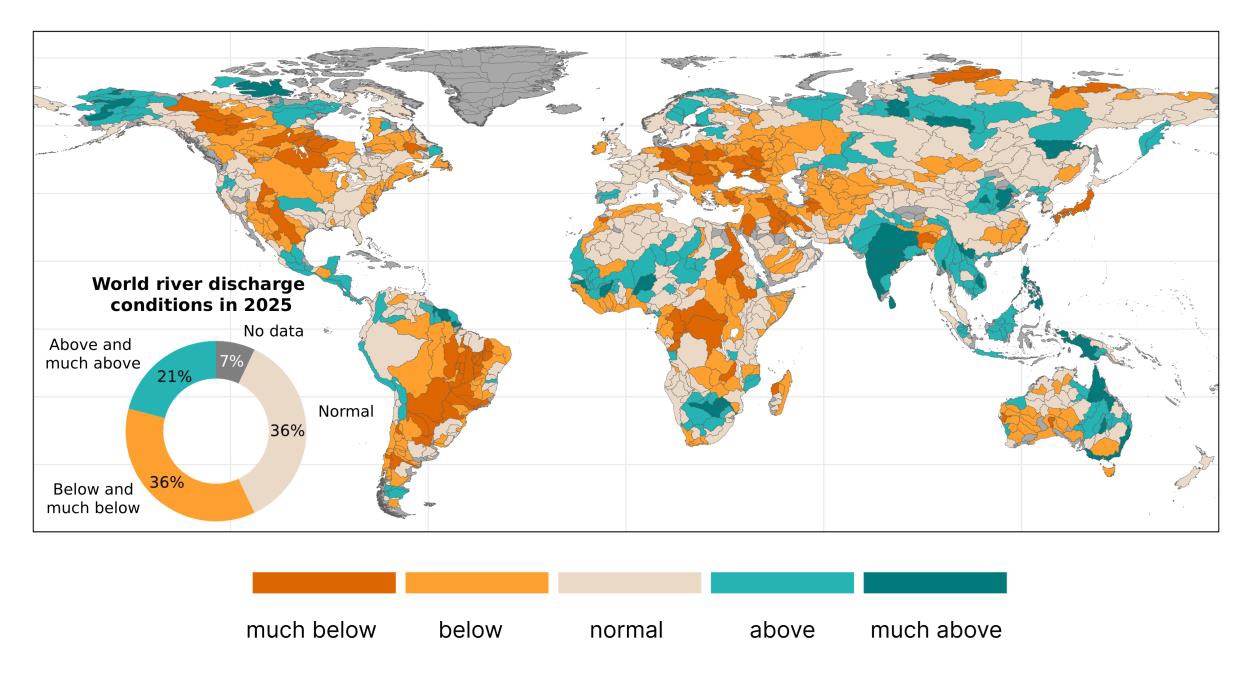
In each of the past five years, there have been record-breaking floods and droughts reported across the world. The hydrological cycle has become more erratic and unpredictable, swinging between too little or too much water.
The UK has experienced a ‘weather whiplash’ in recent years, with wet weather in winter 2024-25, dry conditions in spring and summer 2025 resulting in a drought, then a wet autumn and winter, followed by this year’s intense summer drought.
UKCEH senior hydrologist Dr Katie Facer-Childs said: “There has been little recovery time between many extreme weather events globally in the past few years.
“Therefore, there is an increasing need for careful planning of water resource management to increase our resilience to the impacts of extreme floods and droughts. This will depend upon improving hydrological data and early warning systems across the world, particularly in areas hardest hit by the impacts of floods and droughts.”
Dr Facer-Childs and Lucy Barker of UKCEH were among the international experts who contributed to the State of Global Water Resources, in their capacity as members of the report steering committee.
Improving the evidence base
Professor Harry Dixon, international director at UKCEH, said: “The WMO report is a powerful reminder that understanding our changing planet depends on global scientific cooperation. This will strengthen the evidence base for decision-making to tackle environmental crises, including disaster preparedness and response.”
Professor Dixon added that our scientists ensured UK expertise informed major international initiatives like the WMO report, thanks to National Capability for Global Challenges funding from the Natural Environment Research Council.
UKCEH is coordinating the development of the Global Hydrological Status and Outlook System (HydroSOS). This WMO initiative will provide regular data on the status of water resources – including river flows, groundwater levels, soil moisture, reservoir and lake levels – in catchments across the world.
This will enable a live interpretation of global water resources and seasonal forecasts, including assessments whether conditions are normal for the time of year and the situation is likely to get better or worse over the coming months.
HydroSOS will be providing information similar to outputs produced in the UK by UKCEH but doing it on a global scale. The UK Hydrological Outlook and Hydrological Summary are published monthly while our Water Resources Portal updates data in near real time.