Ecosystems are vital in helping us mitigate climate change but their ability to do so is being reduced by global warming itself. Dr Fabrizio Albanito and Dr Sabine Reinsch, soil health and carbon scientists at the UK Centre for Ecology & Hydrology, discuss the findings of recent research into the impacts of droughts on soils’ ability to retain carbon…
The Global Tipping Points Report 2025 highlights that soils are among the Earth’s most vulnerable climate buffers, with peatlands storing more carbon than all the world’s forests combined. When these waterlogged systems dry, they risk tipping from carbon sinks into sources of greenhouse gases.
This dynamic is mirrored in organo-mineral soils, which are soils featuring a carbon-rich layer on top of a mineral soil layer. Their importance is clear: peat soils cover around 12% of the UK and 3% globally, while organo-mineral soils are widespread across upland regions, accounting for around 40% of Wales and 30% of Scotland. Together, these soils represent critical reservoirs of carbon whose resilience is being eroded by extensive droughts.
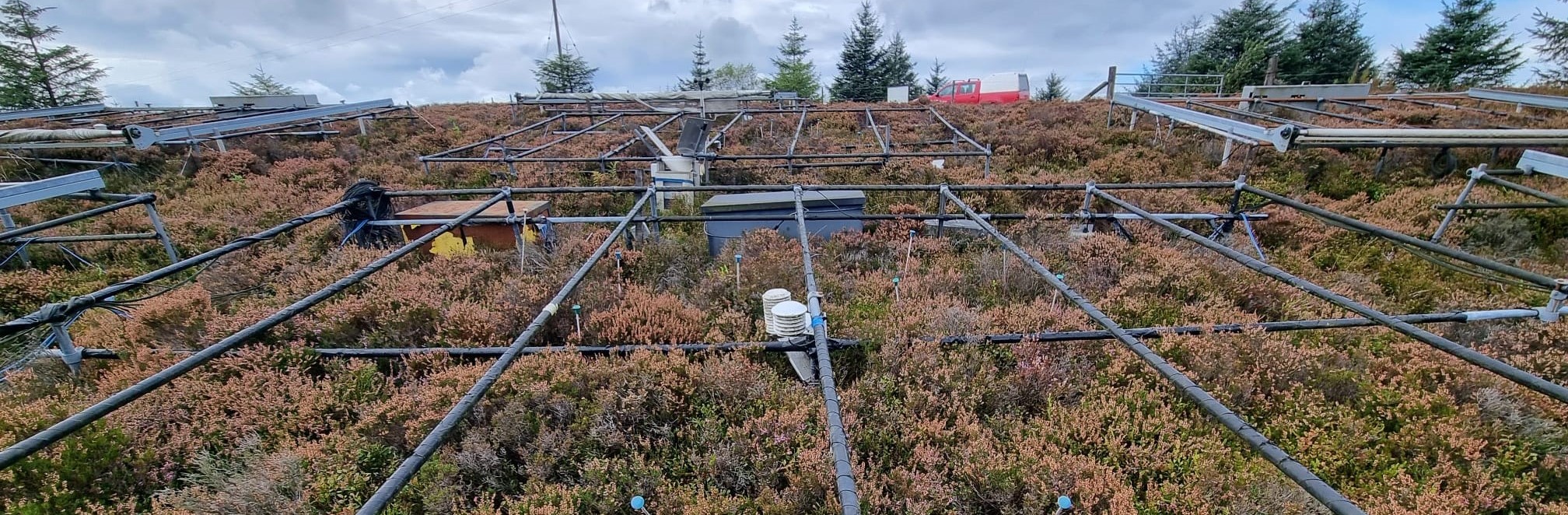
To explore how repeated droughts affect carbon from organo-mineral soils, a recent study led by UKCEH drew on data collected from our long-term climate change experiment in Wales, UK, between 2009 and 2014. Measurements included climate data, soil carbon dioxide fluxes and moisture from both drought and control experimental plots.
Data were fed into a biogeochemical model called ECOSSE which was used to simulate long-term drought scenarios and their impacts on soil organic carbon (SOC) in decomposable and resistant plant material, microbes and humified organic matter.
We modelled four theoretical drought scenarios, with dry conditions lasting 12, 24, 48 or 96 years, each followed by an equivalent recovery period before the next drought began. This model design allowed for the soil system to theoretically experience alternating phases of drought stress and recovery, testing whether the different SOC pools are affected by the length and severity of droughts.
Our study revealed that:
- Frequent drought–rewetting cycles reduced SOC stabilisation in organo-mineral soils
- The study introduced two new process-based diagnostic metrics, carbon sequestration efficiency and stabilisation efficiency, to quantify how drought alters carbon pools within the soil system
- Drought frequency, rather than duration, emerged as the dominant control on long-term soil carbon stability.
Overall, these findings demonstrate reduced resilience of organo-mineral soils under repeated drought exposure producing lasting shifts in carbon stabilisation efficiency and incomplete recovery of SOC stocks following rewetting.
Our findings support broader concerns about soil vulnerability raised in the Global Tipping Points Report. Just as the report cautions that drying peatlands could release centuries of stored carbon, our study shows that recurrent droughts reorganise soil carbon dynamics in ways that persist long after rewetting.
For policymakers and land managers, several priorities emerge:
- Integrate drought frequency into climate models. Current projections often emphasise drought severity, but our findings show that recurrence is the dominant driver of soil carbon destabilisation.
- Maintain soil moisture in peatlands and organo-mineral soils. Safeguarding wetlands, reducing drainage and promoting land uses that retain water is critical.
- Design adaptive land management strategies that enhance soil structure, microbial recovery and formation of humified organic matter. Controlled grazing, vegetation cover and restoration of degraded peatlands can provide a buffer against repeated drought impacts.
Soils are not passive backdrops to climate change — they are active systems whose stability can be altered by repeated droughts. By recognising drought frequency as a critical risk factor and embedding soil resilience into policy, we can help reduced sustained carbon losses and safeguard one of the planet’s most vital climate buffers.
Paper information:
Albanito, F., S. Reinsch, M. Richards, et al. 2026. Frequent Droughts Reduce Carbon Stabilisation in Organo-Mineral Soils. Global Change Biology 32, no. 1: e70657. DOI: 10.1111/gcb.70657.
Albanito, F.; Robinson, D.A.; Reinsch, S. (2025). Modelled soil carbon and nitrogen pools and soil respiration, under control and drought conditions, related to the climate change experimental field site in Clocaenog forest, UK, using ECOSSE. NERC EDS Environmental Information Data Centre. DOI: 10.5285/a81c6520-c116-4e99-810d-23eba79b9b3f
This research was supported by the National Environment Research Council, through the UKCEH National Capability for UK Challenges Programme NE/Y006208/1.

