More than 70 people from research, government and regulatory agencies, NGOs and industry came together for the 11th annual Cumbrian Lakes Research Forum, hosted by UKCEH earlier this November and supported by the National Capability UK Challenges (NC-UK) programme.
The one-day event was composed of a series of fascinating presentations and sessions showcasing how NC-UK long-term monitoring of the Cumbrian lakes is supporting new research and practical action to better understand and manage freshwater environments, demonstrating the importance of sustained environmental monitoring in building evidence, enabling research and connecting people to support policy and practice.
The first session of presentations focussed on the use of monitoring and numerical models to advise freshwater use and restoration. Freya Olsson and George Linney from Radboud University, Netherlands and UKCEH respectively, presented their work to develop positive future scenarios for lake ecosystems and society as part of the EU Water4all project, PLURALAKES. Their work aims to identify levers and optimal pathways of management to deliver desired ecosystem services.
Tim Boden from Ambleside Action for a Future, presented the work of the WET (Waterhead E.coli Testing) project, which includes the monitoring of faecal indicator organisms at Waterhead in Windermere, a popular tourist destination. As part of this work the team have been trialling different approaches to monitoring faecal bacteria, from traditional laboratory methods to rapid field kits. Alex Elliott from UKCEH finished the session showing the results of predicted responses of phytoplankton to different nutrient management measures at Windermere, work that has provided evidence to the “Only Rainwater” project.
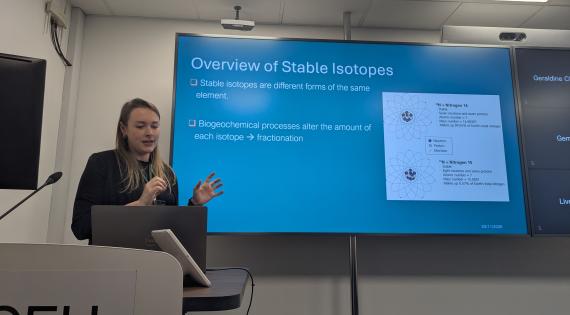
The second session of presentations was centred around the use of novel approaches or tools to monitor lake ecosystems. Savannah Worne, a NERC independent research fellow from Loughborough University introduced her research on developing phosphate oxygen, nitrate and ammonium isotopes to track nutrient pollution in lakes and their sediments using Esthwaite Water, in the Lake District as a case study. Isotopes are atoms from the same element but with different numbers of neutrons. The idea is that different sources of nutrients have different isotope fingerprints so enable us to track the relative contribution of these different sources and how they are cycled biologically and chemically in the lake.
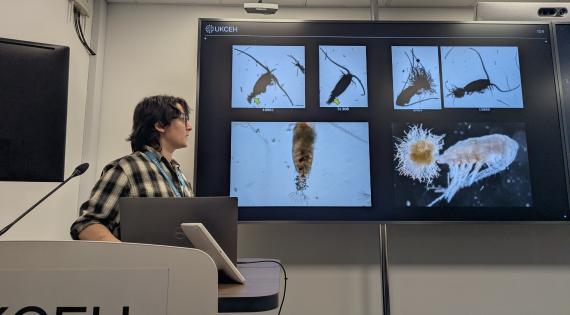
Next up was Lara Walsh, a PhD student based at UKCEH and the University of Stirling who has been using environmental DNA (eDNA) techniques coupled with automated imaging to detect zooplankton parasites. Little is known about the role these disease agents can play in shaping ecosystem interactions but through her work, Lara has uncovered new fungal pathogens that may be more prevalent than previously realised. Amy Thorpe from UKCEH presented her work on tracking the long-term impacts of mining in the Lake District using eDNA from lake sediment cores. This work has identified how microbial communities respond to, and potentially recover from, legacy metal pollution, with shifts in community composition and an enrichment of metal resistance genes that persists long after the mines closed.