The UK Centre for Ecology & Hydrology (UKCEH) delivers far‑reaching economic, environmental, and societal benefits across the UK, according to a new independent assessment by London Economics.
Commissioned in September 2025 and published today, the study examines the economic impact of UKCEH’s activities during 2024, a representative year that reflects the organisation’s typical annual contribution.
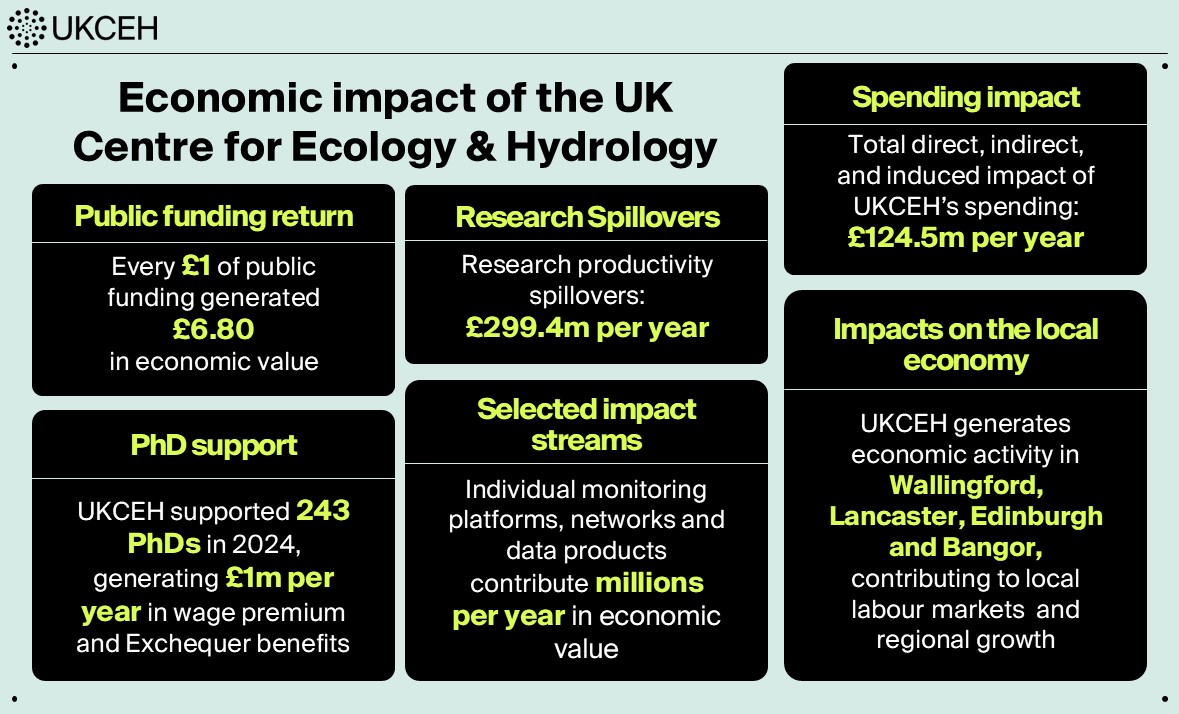
The analysis estimates that UKCEH generated at least £440 million in economic and social value in 2024. This equates to £6.80 of value for every £1 of public funding. These figures are conservative, as only a subset of UKCEH’s activities were assessed in detail.
The findings highlight UKCEH’s role as a cornerstone of the UK’s environmental research infrastructure, demonstrating how world‑leading science and trusted data translate into economic value and growth, improved decision‑making and enhanced environmental resilience.
UKCEH is a leading independent research institute specialising in integrated environmental science across land, water, and air. Its work spans:
- National and other large-scale monitoring networks
- Advanced environmental modelling
- Research, advice and solutions for governments, academia and industry
- Training and supervision of postgraduate researchers
UKCEH Chief Executive Dr Stuart Wainwright said, “UKCEH science provides a critical foundation for our ability to understand environmental changes and what to do about them helping to provide resilience to the world’s emerging challenges.
“The London Economics report highlights the economic value of our science and how it strengthens resilience across food, water, biodiversity and climate, enabling decisions that drives economic efficiency, growth and innovation. As environmental pressures intensify, trusted scientific evidence becomes ever more critical, and UKCEH will remain at the forefront of delivering it.”
How the analysis was conducted
To capture the breadth of UKCEH’s impacts, London Economics used a hybrid approach combining:
- Institutional‑level analysis, assessing economic activity generated through UKCEH’s spending, employment, and research productivity spillovers across its sites in Wallingford, Lancaster, Edinburgh, and Bangor. UKCEH’s international research partnerships further strengthen the UK’s global scientific leadership, ensuring UK‑funded environmental research remains influential on the world stage.
- Detailed case studies, exploring selected impact pathways in depth and illustrating how UKCEH science delivers tangible economic value.
- Land Cover Maps
Nationally consistent land cover data used by government, industry, and academia. Economic value arises from avoided survey costs, reduced analytical effort and more efficient environmental planning. - Cumbrian Lakes Monitoring Platform
Long‑term evidence for key Lake District lakes, including Windermere. The analysis estimates the value of avoiding ecological deterioration — protecting recreation, tourism, cultural heritage, and environmental quality. - Environmental Change Network
The UK’s longest‑running ecosystem monitoring programme. Using the FREEDOM‑BCCR programme as an illustrative example, the study shows how long‑term monitoring of dissolved organic matter supports better water treatment decisions, reducing operational and capital costs.
- Land Cover Maps