Extreme wildfires across Spain and Portugal in 2025 were three times larger due to climate change, and the scale of burning in future years will increase significantly if there is not strong action to tackle global warming.
That is according to the latest global State of Wildfires report, which involves scientists at the Met Office, the European Centre for Medium-Range Weather Forecasts, the University of East Anglia, and the UK Centre for Ecology & Hydrology (UKCEH) alongside experts from over 20 countries.
The annual report provides timely evidence for world leaders as the latest UN climate summit, COP31, gets under way in Turkey. It illustrates how devastating the consequences of wildfires can be for people and ecosystems – causing fatalities, mass evacuations, high costs in damage, major impacts on air quality, and resulting in greenhouse gas emissions from carbon-rich ecosystems.
Iberia was one of the three key regions analysed for the report, alongside Canada – which experienced a third consecutive extreme wildfire season in 2025-26 – and Chile. The study combined satellite observations of wildfires, vegetation cover and weather conditions with multiple weather, climate and fire models to assess climate change's impact on fire risk.
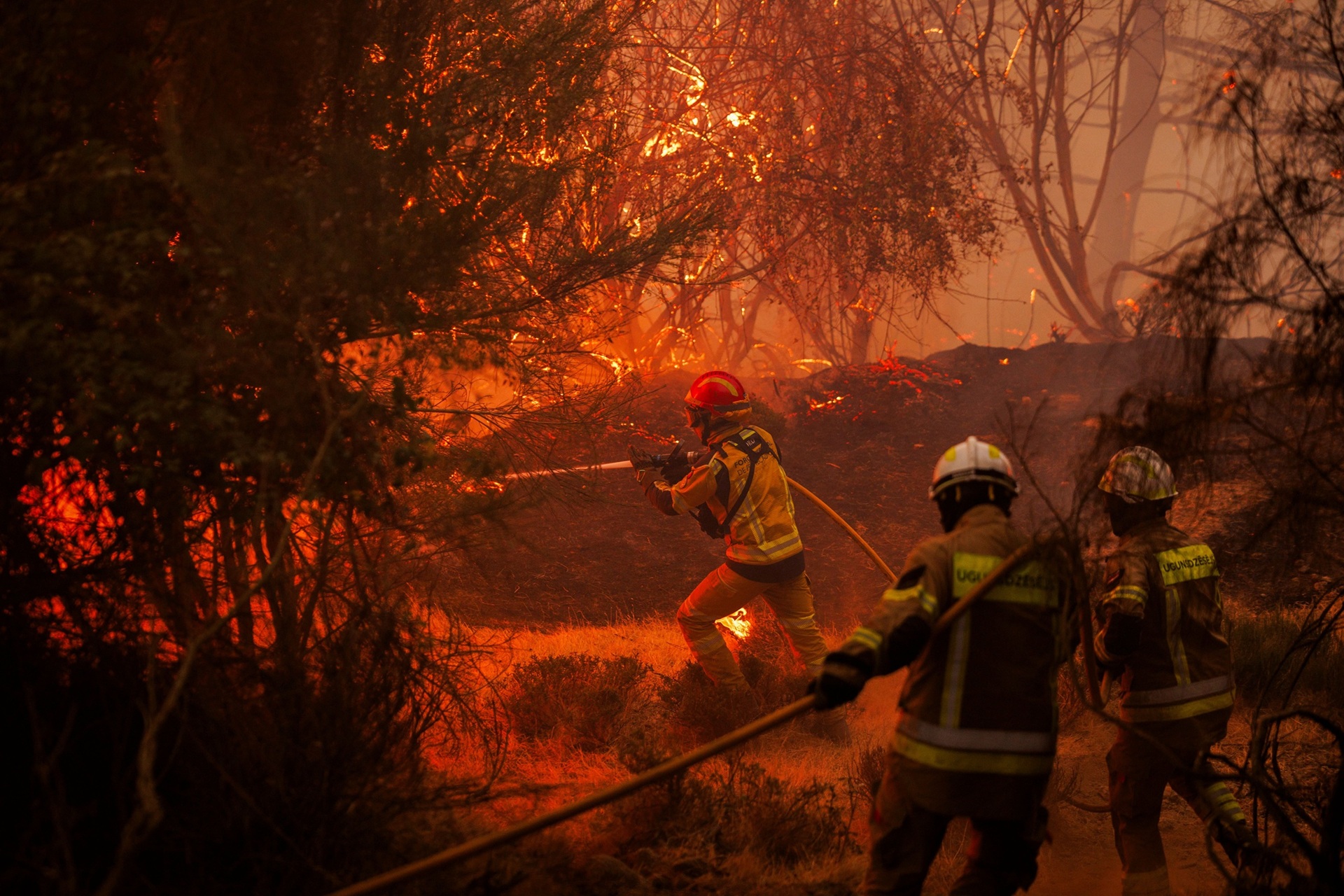
The wildfire season last year was particularly severe in Iberia, where 14 people died, and more than 40,000 people were evacuated as 14 megafires – defined as a burned area of at least 100 square kilometres – raged in the region. Spain recorded its highest burned area since records began in 2002, and Portugal saw the largest single wildfire on record.
Globally, the 2025-2026 fire season saw the lowest global burned area and fire emissions on record, driven by low burning in African savannas. Yet this hides exceptionally severe regional extremes in certain regions.
Warning over warming
Future projections led by Dr Douglas Kelley for the State of Wildfires report show that, although climate change is expected to continue increasing wildfire impacts, some of the worst future outcomes once considered plausible are now less likely. In Spain and Portugal, fires similar to July-August 2025 are projected to burn around 78% more area by the end of the century under a high-emissions scenario.
However, this is substantially lower than projections under the pessimistic high-emissions futures that were considered plausible a decade ago. Strong action to reduce greenhouse gases in line with the Paris Agreement would limit the increase in burned area to 15%.
"Our report shows both a warning and a reason for hope," said Dr Kelley.
"Climate change is already making extreme wildfires larger and more damaging, and some further increases are now difficult to avoid. But the future is not fixed. Some of the worst wildfire futures considered plausible a decade ago are already less likely, and world leaders meeting at COP31 still have an opportunity to further reduce future wildfire impacts through strong action on greenhouse gas emissions."
The study also provides an overview of wildfire activity in other parts of the world, noting the UK had its first megafire, at Dava Moor in the Scottish Highlands in June 2025, and recorded its highest national burned area since records began in 2002.
Report information
The study, which examined the fire season from March 2025-February 2026 is the third such annual report. It is published as an open access paper by Earth System Science Data.
The international research team of 60 experts included Douglas Kelley and Maria Barbosa of UKCEH, whose work for the study was funded by the Natural Environment Research Council.