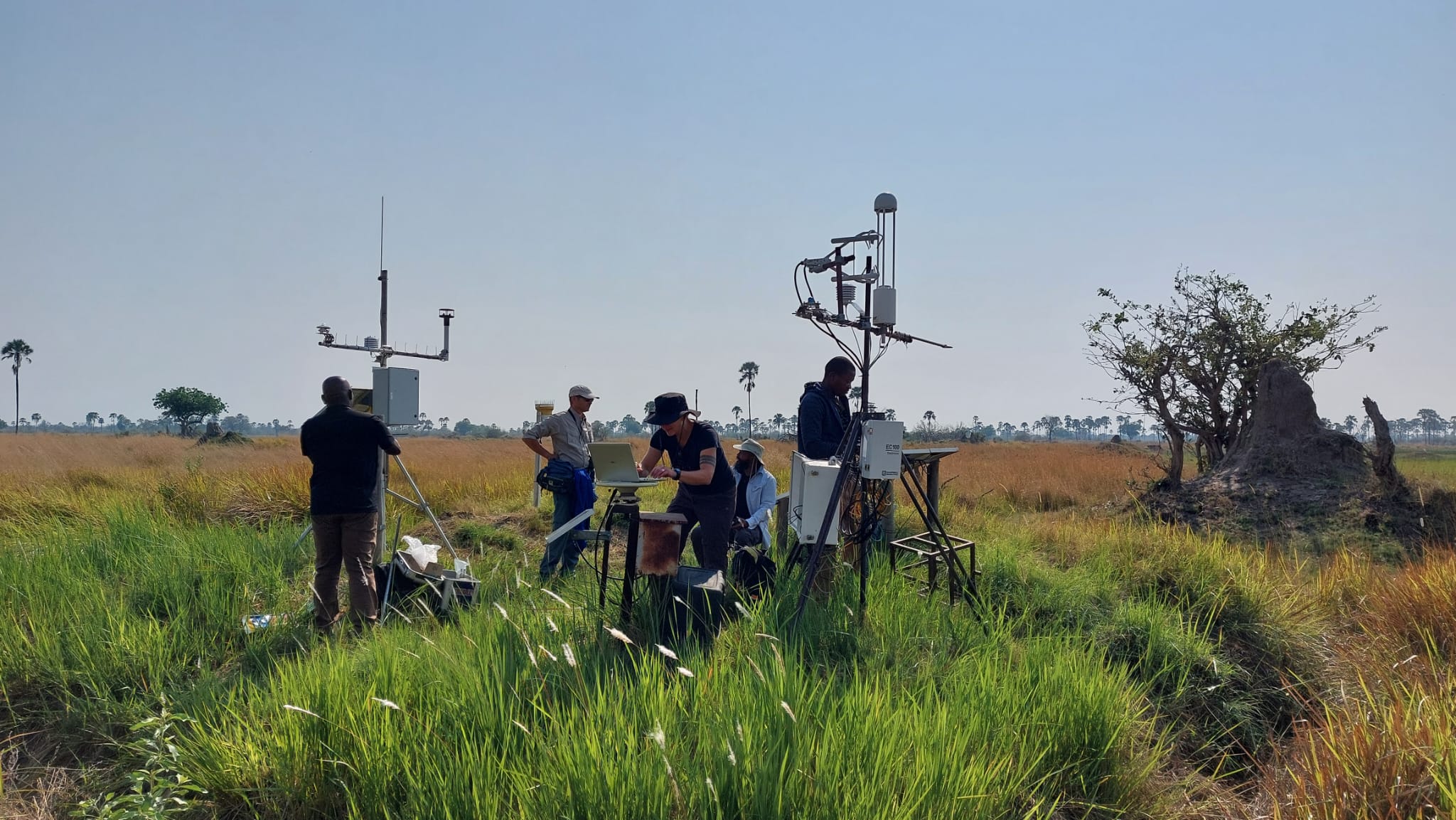
UKCEH environmental physicist Dr Carole Helfter reflects on 10 years of continuous research in Southern Africa. From the setting up of the first long-term measurements of methane emissions from African wetlands in Botswana to the recent establishment of a brand new monitoring tower in Zambia, Carole highlights the collaborations and outputs resulting from this important research.
I first began working in Botswana a decade ago under the auspices of the NERC Highlight project MOYA (Methane Observations and Yearly Assessments). MOYA was an ambitious programme that sought to better constrain the global methane budget through a combination of measurements, Earth observation and modelling. The greenhouse gas measurement team at CEH Edinburgh was tasked with establishing a new collaboration with scientists at the Okavango Research Institute (ORI), a department of the University of Botswana, and setting up two eddy-covariance (EC) sites in the Okavango Delta.
Our aim was to study methane and carbon dioxide emissions from two contrasting wetland systems over the course of a year, providing what were effectively the first methane flux datasets from African wetlands. The CEH experimental team was small but dynamic, consisting of Professor Ute Skiba (now retired) and me. We travelled to Botswana on 1 October 2016 for a scoping mission, arriving just as the celebrations marking the 50th anniversary of Botswana's independence, known as BOT50, were drawing to a close. In Maun, we were welcomed by Dr Mangaliso Gondwe and Prof Mike Murray-Hudson from ORI, who organised scoping trips into the Okavango Delta. Following these surveys, we selected a permanent Cyperus papyrus swamp at Guma Lagoon and a seasonal floodplain at Nxaraga, in the Moremi Game Reserve, as suitable locations for EC measurements.
Ten years later, those EC sites are still operating. The measurements never really stopped, not even during the COVID-19 pandemic, thanks to the dedication and commitment of ORI staff. Casting scientific humility aside for a moment, this is a remarkable achievement. These records are now among the longest, perhaps are the longest, continuous methane flux datasets from African wetlands, making them highly valuable to the international research community.
The collaboration has delivered outstanding science. Under MOYA, we published a number of influential papers in leading journals and subsequently secured new funding (2023-2026) from the Gordon and Betty Moore Foundation, which recognised both the uniqueness and value of the datasets from data-poor regions of Africa. This success was followed by a NERC large grant, CurFEW (Current and Future Emissions of Wetland methane; 2025-2030).
If MOYA was ambitious, CurFEW is turbo-charged. The project spans multiple spatial and temporal scales and draws together state-of-the-art observational and modelling expertise. Although the experimental, "boots-on-the-ground" work package that I lead represents only one part of the programme, it plays a central role in delivering CurFEW's scientific objectives.
As part of CurFEW, I returned to Botswana in 2026 to install new sensors and implement additional measurements. My visit coincided with BOT60, the 60th anniversary of Botswana's independence, which I celebrated with ORI friends and colleagues at the Maun campus. I even sampled the traditional sorghum beer, though I will reserve judgement on its merits.
From Botswana, I travelled onward to Zambia to begin the next exciting chapter: the establishment of a brand new EC tower in Kafue National Park. The work in Zambia is being carried out in collaboration with Game Rangers International (GRI), an NGO dedicated to combating poaching, reducing human-wildlife conflict and rehabilitating orphaned elephants. Although not an academic partner, GRI's enthusiasm for and commitment to the science has been unwavering. After months of preparation, including obtaining research permits, shipping instrumentation and navigating customs clearance, the equipment finally arrived at GRI's Musa Camp in southern Kafue. After three long, hot days of hard physical work, particularly for the casual workers who dug a protective trench around the equipment to deter curious elephants, the EC tower was finally standing.
The current plan is for measurements to continue for at least one year. However, our experience in Botswana has taught us that even the most carefully laid plans do not always unfold as expected. Perhaps, with a little luck, I will find myself writing another blog post in ten years' time, celebrating the longevity of the Nkala EC site and reflecting on where this latest chapter has taken us.
Find out more about CurFEW.
