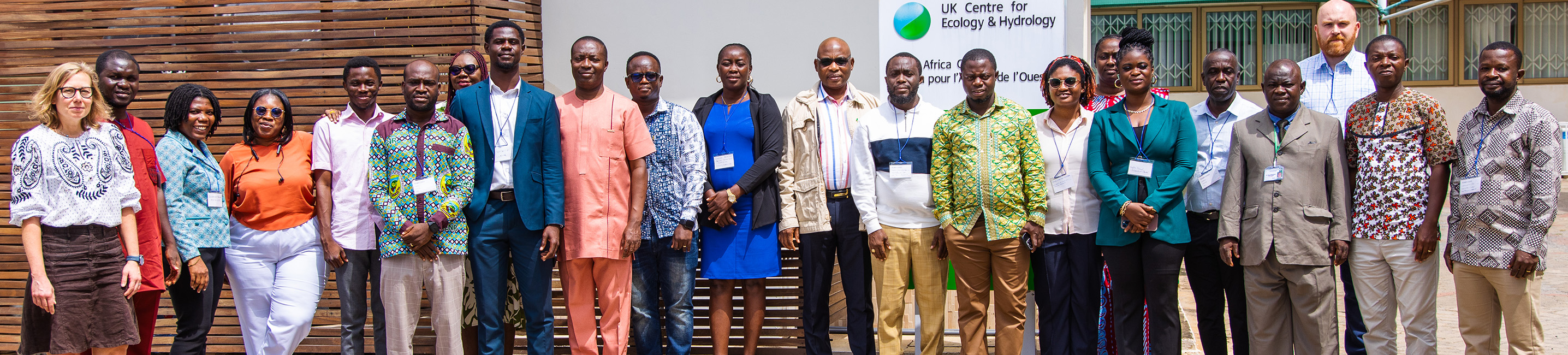
In October 2025, the UK Centre for Ecology & Hydrology (UKCEH) hosted a two-day workshop at its West Africa Office in Accra, Ghana, bringing together 20 experts from Ghana, Liberia, Nigeria, and the UK. The group met to discuss a question that’s vital to the region’s agronomic future: how can West Africa grow oil palm sustainably, while improving livelihoods for smallholder farmers?
Oil palm is native to the region and a key source of income for millions of households. Yet, compared to large-scale plantations in Southeast Asia, West African yields remain low (less than half) as farmers face significant regional challenges. At the same time, growers are under increasing pressure to manage environmental issues such as waste, greenhouse gas emissions, and soil degradation, all while dealing with the unpredictable impacts of climate change.
The workshop brought together researchers, government officials, NGOs, and industry partners to share experiences and identify priorities for action. Discussions covered everything from improving farming practices and managing waste to strengthening local institutions and building resilience to climate extremes.
It was widely accepted that research and innovation should be tailored to local realities. Smallholder farmers operate in diverse conditions and often lack access to expensive technology or inputs (no access to credit). That means future work needs to focus on simple, affordable, and scalable solutions that work for local communities first and foremost.
Waste management was another hot topic. Large quantities of by-products of oil palm processing are often discarded (> 95% of all plant materials) but could be better utilised as compost feedstock. Participants weighed the pros and cons of composting versus biochar, agreeing that while biochar can lock carbon into the soil, composting is more accessible and affordable for smallholders.
The conversations also turned to the human and policy dimensions. Frequent changes in government, reduced subsidies, limited access to finance, and weak cooperative structures all make it difficult for smallholders to invest and plan ahead. Land insecurity adds another layer of uncertainty, with many farmers working plots they don’t formally own. Participants agreed that sustainable change will require policy consistency, better support systems, and fairer access to resources and credit.
The workshop ended with a shared commitment to keep the momentum going. Rather than jumping straight into large projects, participants agreed it makes sense to start by building partnerships through pilot studies and practical collaborations that can grow into something bigger over time. The workshop highlighted that there is a strong appetite across the region to work together, combining science, local knowledge, and community engagement to build a palm oil sector that’s both productive and sustainable.
Acknowledgements
This workshop was primarily funded by the UK Natural Environment Research Council (NERC) Seedcorn “Addressing environmental impacts of oil palm expansion in Liberia/Africa” (Grant Ref: NE/Y003136/1), with additional support from NERC National Capability Science: International award “Options for Net Zero Plus and Climate Change Adaptation” (Grant Ref: NE/X006247/1).