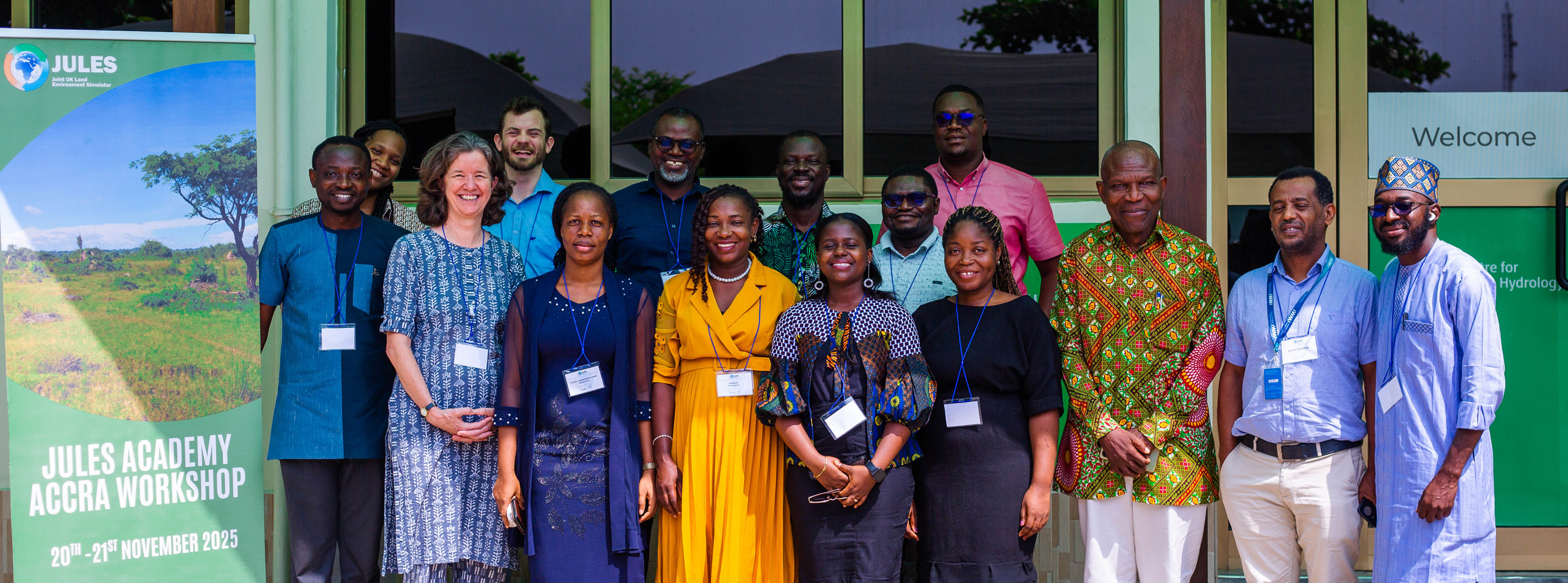
JULES Academy took an important step forward recently when it hosted its first in-person workshops in Accra, Ghana and Nairobi, Kenya in November 2025. These events followed the Academy’s pilot online training programme in September 2025 and brought together early-career researchers, operational agency staff and regional partners from across East and West Africa.
What is JULES Academy?
JULES Academy was launched in 2025 with funding from UKCEH’s National Capability for Global Challenges programme. Its aim is to introduce African scientists and practitioners to the JULES land-surface model and to build a self-sustaining community of users and developers across the continent.
JULES (Joint UK Land Environment Simulator) is the land-surface component of the UK Met Office’s weather and climate prediction system and is used widely as a stand-alone research tool to study land–water processes such as agriculture, forestry, floods, droughts and water resources.
Africa has unique, regionally specific land–atmosphere interactions, yet process-based models like JULES have historically been developed by expert scientists using data from the Global North. JULES Academy is helping to change that.
From online training to in-person exchange
In September 2025, the Academy delivered a week-long online training course to 24 participants from 18 institutions in 9 countries. The Accra (20–21 November) and Nairobi (24–25 November) workshops were designed to:
- assess how participants were using JULES after the course,
- gather feedback to improve the Academy in 2026,
- and strengthen relationships with regional partners as the foundations of East and West African hubs.
Participants included representatives from universities, national meteorological services, research institutes and regional centres such as Addis Ababa University, Kenya Meteorological Department (KMD), International Water Management Institute (IWMI) and West African Science Service Centre on Climate Change and Adapted Land Use (WASCAL).
The workshops showed strong enthusiasm for JULES, and participants presented their plans for work with JULES across a variety of technical fields. The workshops also highlighted key demands of the participants, for example many preferred future training to have an increased focus on practical applications of JULES (such as for hydrology and land-use planning), and the creation of a JULES Africa helpdesk or forum to provide follow-up support was widely requested.
One workshop participant said: "The workshop was very well organised and highly relevant. I particularly appreciated the practical focus, clear explanations from the facilitators, and opportunities for discussion and networking with participants from diverse backgrounds. The balance between theory and real-world examples made the content engaging and easy to apply."
Looking ahead
UKCEH is now working with key partners to formalise co-leadership arrangements for JULES Academy in 2026. Planning is underway for the next phase, including new training courses, network-building activities between the East and West Africa hubs, and ensuring it reaches the right communities.
The Accra and Nairobi workshops marked the beginning of what we hope will become a vibrant, Africa-led network of JULES users — unlocking the potential of land-surface modelling to support climate resilience, water security and sustainable development across the continent.
Eleanor Blyth