Image
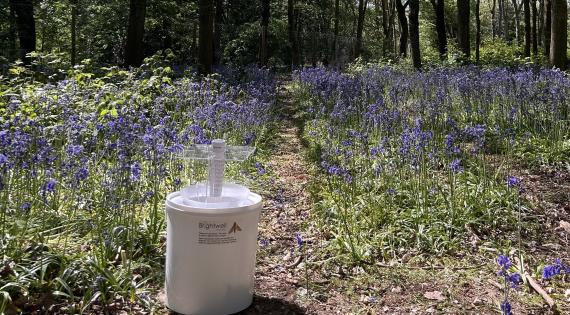
Brightwell bucket moth trap placed in a woodland in front of bluebells

Moths are an incredibly diverse part of our ecosystems. Using light traps to capture moths is a simple way to find out more about the quality of habitats and how they are changing over time. Many moths are important pollinators and are a vital part of food chains – providing food for birds, bats and small mammals. Recording moths helps us track the health of our ecosystems.

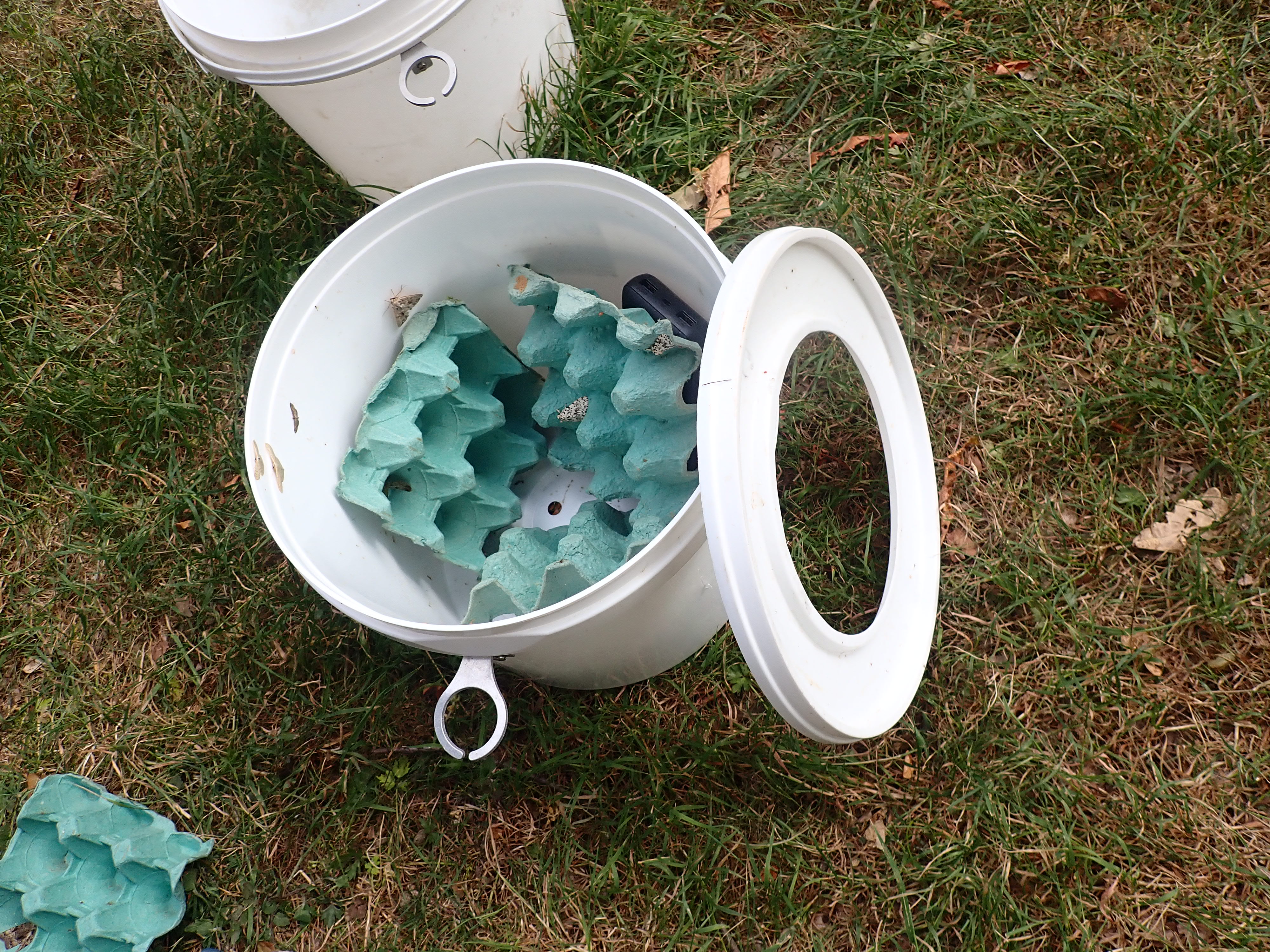
Brightwell Moth Traps are designed for your moth recording: whether doing moth recording for ecological surveys, for scientific research, for your own enjoyment or to engage others with the wonder of the diversity of moths. Moths are attracted to the light and retained in the bucket for identification and release in the morning.

There are many types of moth trap, but we have designed Brightwell Moth Traps as an “LED bucket trap” to be as simple as possible to produce. They simply slot and click together. The electronics are simple: the in-built light sensor turns the lights on at dusk and off at dawn, making them ideal for portable use. Plug in a portably power pack and leave it, returning the following morning to see what has been captured. Brightwell Moth Traps have been developed as part of a programme of work on farmer-led moth monitoring, but can be used by anyone.

Designed for moth recording. Share your moth records for biodiversity monitoring and conservation. We recommend using iRecord or e-Surveyor, so that your records will be shared with the National Moth Recording Scheme and Local Environmental Records Centres. 

Designed to be used with e-Surveyor. Identifying moths can be difficult. Brightwell Moths Traps are designed to (optionally) work with the freely-available e-Surveyor app. This uses AI to identify the moths and gives you insights about the moths that you recorded.

Coming soon: open access designs. We will soon be making the full design of the traps open access. This will include files for laser cutting and designs for the electronics.

Coming soon: results of the validation. We’re finishing off the analysis of the validation tests in comparison with other moth trap designs. We’ll post the link to a preprint of the comparison as soon as it is complete.

FAQs

Interested in purchasing?

To make these traps accessible, we are making them available to purchase in batches of 10 (terms and conditions apply). Please contact brightwellmothtraps@ceh.ac.uk to request a quote or for more information. The purchase of Brightwell Moth Traps does not include power banks.

Brightwell Moth Trap Privacy Notice

Funders and collaborators

The development and production of the Brightwell Moth Traps is led by Abigail Lowe and Michael Pocock. We thank Marc Botham, Jonas Beuchert, Tom August and Martin Harvey for their contributions to the design, development and testing. 

Instructions on constructing LED bucket moth traps have been made available by Dutch Butterfly Conservation, and similar designs made available by Butterfly Conservation in the UK. The Brightwell Moth Trap design builds on these, identifying opportunities for further improvement through use and testing. 

The development of the Brightwell Moth Traps was funded by the Natural Capital and Ecosystem Assessment programme of Defra, supported by JNCC. Field testing was supported by the TRANSFORM project, funded by EU and UKRI. 


FAQs

What makes Brightwell Moth Traps special?

Brightwell Moth Traps were born out of the need to develop a moth trap that was: standardised, simple to construct and use, robust and portable. We have tried to make the design as easy to produce as possible to make it inexpensive and accessible to as many people as possible. There are many other designs of moth trap, including other “LED bucket traps”.
The key aspects of the design are:

  • Acrylic vanes that slot and click together, removing the need for complicated fixings, and a polypropylene clip-together funnel. Both can be flat packed.
  • A standardised LED specification that has been validated in its ability to attract moths and minimises the need for specialised electronic components when used with a 5V power pack (supplied by user; we recommend 20,000mAh).
  • A small ‘light controller unit’ that includes a light sensor and has a ‘keep alive’ component for the power pack (i.e. to prevent the power pack’s auto-off function stopping the LEDs working). 
     

What do you mean by saying these moth traps are 'validated'?

We have run field trials in farmland and woodland to optimise our moth traps designs, including the best number of LED chips to use. We have used an experimental design to compare Brightwell Moth Traps with the widely-used Heath traps with an actinic bulb. Brightwell Moth Traps with 60 LED chips catch roughly two-thirds the number of moths compared to an actinic Heath trap.

What if I want to maximise the number of moths when sampling?

Other types of moth traps, like Robinson traps with MV bulbs, will catch many more moths than our Brightwell Moth Traps, but require portable generators or larger batteries. Our aim was to create an inexpensive, portable moth trap, building on experience from others who have trialled LED bucket traps. If you want to catch more moths in a location you could try using more Brightwell moth traps, or use a different moth trap. The choice is yours!

What LED chips do you use?

The specification of the LEDs are: 5V, IP20, 2835 chips, 395nm. These are widely available online as ‘party lights’ or ‘uv lights’.

Are the LEDs safe?

Yes. “UV insect lights” (for fly traps; which operate at 350-400nm) are regarded as having “potential to cause harm if used inappropriately, eg placed extremely close to the eyes or skin, but which are perfectly safe under normal conditions of use”. (Guidance for Employers on the Control of Artificial Optical Radiation at Work Regulations (AOR) 2010, HSE). The LEDs that we use have a reported peak of 395nm 

I want a trap for pest moths. Will this help?

Our traps are designed to survey moths, not to deal with pest species. Only a few species of moth are pests (by eating carpets, crops or garden plants) – the vast majority of species are a positive and important part of ecosystems. 

I have found a Brightwell Moth Trap on my land. What do I do?

Brightwell Moth Traps with the UKCEH logo are supplied by us, but used by a wide range of different people. It is the responsibility of the user to make sure that they are safe and legal – including getting permission from the landowner. The moth traps do not harm the moths; the moths will be released once they have been recorded. 

Why call them 'Brightwell' Moth Traps?

We wanted a name so that it was easy to show that this is a standardised, validated method. We ran the first tests of our traps in fields and woods within sight of Brightwell Barrow, a prehistoric hilltop monument near the UK Centre of Ecology & Hydrology in Oxfordshire. We realised that the name seemed perfect for a moth trap design!

Privacy notice

April 2026

1. Who we are
This activity relates to the Brightwell Moth Trap, which is supplied by the UK Centre for Ecology & Hydrology (UKCEH) for research, environmental monitoring, training and public engagement purposes.
UKCEH is an independent, not-for-profit research institute and is a registered Charity in England & Wales (number 1185618) and in Scotland (number SC049849), and a registered Company Limited by Guarantee in England & Wales (number 11314957).
UKCEH is the controller for all processing of personal data for the purposes of administering and supporting the research use of the Brightwell Moth Trap. The main UKCEH Privacy Notice is here.

2. Why are we collecting your information?
UKCEH collects the minimum amount of personal data necessary to administer the supply and research use of the Brightwell Moth Trap and to communicate with you in connection with that use.

This Privacy Notice covers personal data collected in relation to the Brightwell Moth Trap, including:
enquiries about the device; provision of the device for research use; safety queries, issue reporting or incident notifications; and feedback relating to the design, use or safe operation of the device.

The personal data about you that we may collect includes:

  • Name
  • Email address
  • Organisation name
  • Telephone number

In data protection terms, we are using the lawful basis of Consent for collecting and processing your personal data.

All data held by UKCEH is processed in accordance with UK data protection legislation, and the basis on which we process any personal data we collect from you, or that you provide to us, is covered by the UKCEH Privacy Notice.

This research-related activity has undergone appropriate ethical and governance scrutiny within UKCEH to ensure that it is conducted in a way that protects participants’ interests and meets required standards. You will be informed about what information is collected and how it is used, and consent will be obtained before your personal data is processed.

3. How are we storing your information, and will we share it?
The personal data that we collect will be stored securely on UKCEH systems and in compliance with UK GDPR for as long as we may need to engage with you in relation to the Brightwell Moth Trap. We will then anonymise the personal information we hold about you.

Sharing your personal information
Anonymised information (for example, aggregated feedback or high-level reporting data) may contribute to internal learning, guidance, or research outputs. UKCEH will not use any information that would identify you in publications, presentations or public communications without obtaining your specific consent first.

Other than as set out above, and except where we have a legal obligation to do so, we will not share your personal data with anyone else, and we will always adhere to current UK data protection legislation.

4. Your rights and legal purpose
The GDPR (General Data Protection) clearly defines individual’s rights for your data. We are collecting and processing this data under Consent. Your rights are as follows:

  • you have the right of access to your data*
  • you have the right to correct your data if it is incorrect*
  • you have the right to ask for your data to be deleted*
  • you have the right to withdraw your consent at any time*

* For data that has not been, or is anonymised

You should contact the Brightwell Moths Team at brightwellmothtraps@ceh.ac.uk if you have a query about how your data is used in the research project.

If you have any concerns or complaints about how your personal data is being used, we will try to answer any questions you have. The UKCEH Data Protection Officer can be contacted at cehdataprotection@ceh.ac.uk

You also have the right to lodge a complaint with the Information Commissioner’s Office. You also have the right to an effective judicial remedy against decisions of the Information Commissioner’s Office.

Deletion of Data
Personal data will be stored only for as long as is necessary to support the research use, safety oversight and administration of the Brightwell Moth Trap. After this point, personal data will be securely deleted or anonymised in line with UKCEH retention policies.

5. Changes to the Privacy Notice for UKCEH
This Privacy Notice may be updated from time to time. The latest version will always be available on the Brightwell Moth Trap site. If changes are made to this Privacy Notice in the future, a prominent notice will be posted on the website.