UNCCD Good Practice Guidance – Harnessing the latest drought science to inform a Global Framework for Monitoring Climate Risk and Resilience

As climate change intensifies, droughts are becoming more frequent, severe, and widespread. With over two billion people projected to be exposed to drought by 2100, the need for robust, harmonised monitoring systems has never been more urgent.  

In response, the United Nations Convention to Combat Desertification (UNCCD), the global treaty addressing drought, land degradation and desertification, commissioned the development of Good Practice Guidance (GPG) to support national reporting on progress towards Strategic Objective 3 (SO3): “To mitigate, adapt to and manage effects of drought in order to enhance the resilience of vulnerable populations and ecosystems.” 

Prepared by scientists at the UK Centre for Ecology & Hydrology (UKCEH), the GPG provides a globally applicable framework for monitoring drought hazard, exposure, and vulnerability. It equips countries with the tools to track progress against the Strategic Objective, and in turn identify appropriate proactive measures to mitigate drought impacts and develop strategies and policies to adapt to changing climate conditions over the longer-term.
Development and scientific foundations

The GPG was designed to balance scientific rigour with practical usability, while adhering to globally agreed standards and recommendations. It involved: 

  • Reviewing state-of-the-art drought monitoring methodologies 
  • Appraising global datasets and indicator frameworks 
  • Engaging with stakeholders, data providers, and international bodies eg World Meteorological Organization (WMO) and Joint Research Centre (JRC) 
  • Designing workflows and worked examples for country-level application 

The guidance was shaped through global collaboration and peer review, ensuring relevance across diverse ecological and socio-economic contexts, remaining flexible for country Parties to use their own national data. 

Implementation and capacity building

Since its publication in 2021, UKCEH has continued to support the rollout and evolution of the GPG as part of the National Capability for Global Challenges programme. Key activities include: 

  • ‘Train the trainer’ webinars to support national and regional implementation 
  • Community-wide webinars  
  • Dissemination at global and scientific forums such as Drought Resilience+10, and Assemblies of the International Association of Hydrological Sciences (IAHS) and European Geosciences Union (EGU) 
  • Development of drought index toolkits like GMID (Global Multi-Index Drought dataset), provided as a default dataset to support the second round of national reporting 
  • Scientific analyses exploring new indicators, future drought exposure and ecological resilience frameworks 
  • In-country engagement in Ghana and Thailand to demonstrate data applications and test methods 

These efforts have significantly strengthened global capacity for drought risk assessment and fostered a proactive, risk-management approach.

Impact on global reporting

The GPG was used in the first round of SO3 reporting for the 2000–2015 baseline and 2016–2019 period. Results from the 111 national reports submitted include: 

  • 98 countries were affected by drought during 2016–2019, with 15 countries experiencing severe or extreme drought 
  • 101 countries reported on population exposure to drought, covering about 40% of the global population and 50.8% of land area, with over one third of the reported total population exposed to drought 

These reports are accessible via the UNCCD Data Explorer, offering transparency and comparability across nations. 

UNCCD Chief Scientist, Barron Joseph Orr, said: “UKCEH’s leadership in developing the Good Practice Guidance has empowered UNCCD country Parties to assess drought hazard, exposure and vulnerability through a flexible, globally applicable framework. Their training has strengthened national capacities for the first round of reporting and is supporting preparations for the 2026 cycle.  

“Through continued engagement at UNCCD COPs, UKCEH has helped communicate the value of this guidance and its relevance for a post 2030 Strategic Framework. The provision of global drought indicators has further enabled countries to undertake higher resolution assessments of drought risk, enhancing the quality and consistency of reporting worldwide.” 

Country-level innovation

Mexico, South Africa, and Lebanon were highlighted in a case study ‘The Land Story: country experiences with reporting on land degradation and drought’ for their advanced vulnerability assessments. These countries incorporated sub-national and sex-disaggregated data, enabling more targeted drought preparedness strategies. South Africa’s long-term analysis revealed a gradual decline in vulnerability since 2014.

UKCEH at UNCCD COP16: Driving global dialogue

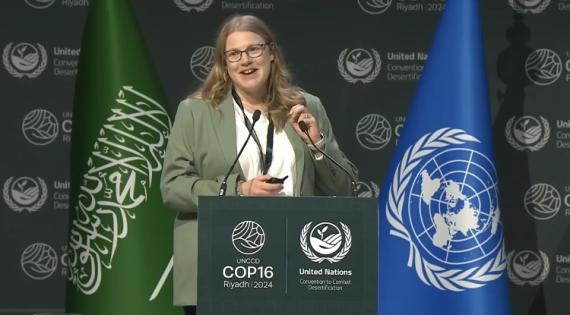
At UNCCD COP16 in Riyadh (Dec 2024), Lucy Barker, lead author of the GPG, presented at a joint plenary session of the Committee for the Review and Implementation of the Convention (CRIC) and Committee on Science and Technology (CST) on the post-2030 Monitoring Framework. She outlined possible future enhancements which UKCEH have been testing and developing within the NC International Programme, including: 

  • Adoption of the Standardised Precipitation Evapotranspiration Index (SPEI), to meet new WMO drought monitoring recommendations  
  • Hydrological drought monitoring 
  • Ecosystem resilience indicators 

Lucy Barker, Senior Hydrological Analyst, said: “UNCCD COP16 showed a clear step‑change in global ambition on drought resilience. Compared with COP15 in Abidjan in 2022, the scale of engagement in Riyadh was striking, bringing together policymakers, researchers, civil society and the private sector. It was inspiring to see countries like South Africa and Mexico actively applying the Good Practice Guidance, demonstrating how it is already supporting national‑scale drought resilience and risk analysis. Hearing first‑hand about countries’ experiences in using the Guidance - and their desire to better assess ecosystem exposure and resilience to drought - underlined its growing value and the need for continued scientific support.” 

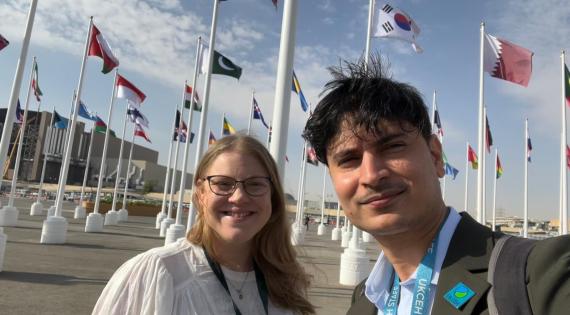
Lucy and Srinidhi Jha participated in the One Water Summit, which contributed to the ongoing United Nations discussions and process to enhance global water governance, accelerate action on the Sustainable Development Goal 6 (clean water and sanitation), and act as an incubator for solutions, in preparation for the next UN Water Conference in 2026.  

UKCEH hosted a booth in the UK Pavilion, supported by the FCDO Science and Innovation Network. The delegation engaged with global stakeholders exploring avenues for future collaboration on regional and global initiatives. 

Dr Srinidhi Jha reflected on the experience: “COP16 was inspiring. It was incredible to see global unity – from institutions to indigenous communities – on the urgency of drought action. The scale of ambition was clear, but so was the need for sustained investment and innovation.”

Image
Lucy Barker behind lecturn with microphones presenting, UNCCD backdrop and green and blue flags behind

Lucy Barker presenting

Image
Lucy Barker and Srinidhi Jha with lots of flags behind at UNCCD COP16

Lucy Barker and Dr Srinidhi Jha at UNCCD COP16

Advancing science and policy

The GPG set out a series of possible future developments for the reporting, some of which have been recommended by UNCCD country Parties and adopted for the second round of reporting (2026-2027). This includes the provision of GMID data enabling high-resolution hazard assessment using both the SPI and SPEI.   

Through the NC-Global Challenges Programme, UKCEH’s scientific work continues to support the development and improvement of SO3 reporting. This includes: high-resolution indicator development for Ghana relevant to impacts on agriculture, the development of ecological resilience frameworks, and assessments of future drought exposure at the global scale, demonstrating the GPG’s adaptability and relevance for ongoing drought risk assessment from the local to global scale. 

Technical and advisory excellence

The GPG exemplifies technical assistance and advisory services in climate risk analysis, enabling regional implementation. It includes: 

  • A robust risk assessment framework with separate indicators for hazard, exposure, and vulnerability 
  • Capacity building through training and webinars 

Harry Dixon, Associate Director of International Research and Development, said: "The UNCCD Good Practice Guidance, developed by UKCEH, is a landmark achievement in global drought resilience. Our scientists worked with partners from across the multilateral system to pioneer a new approach to drought monitoring that empowers countries to monitor risk, inform policy, and collaborate on solutions. Its uptake in national reporting, integration into global dialogues, and continued scientific evolution underscore its transformative impact."