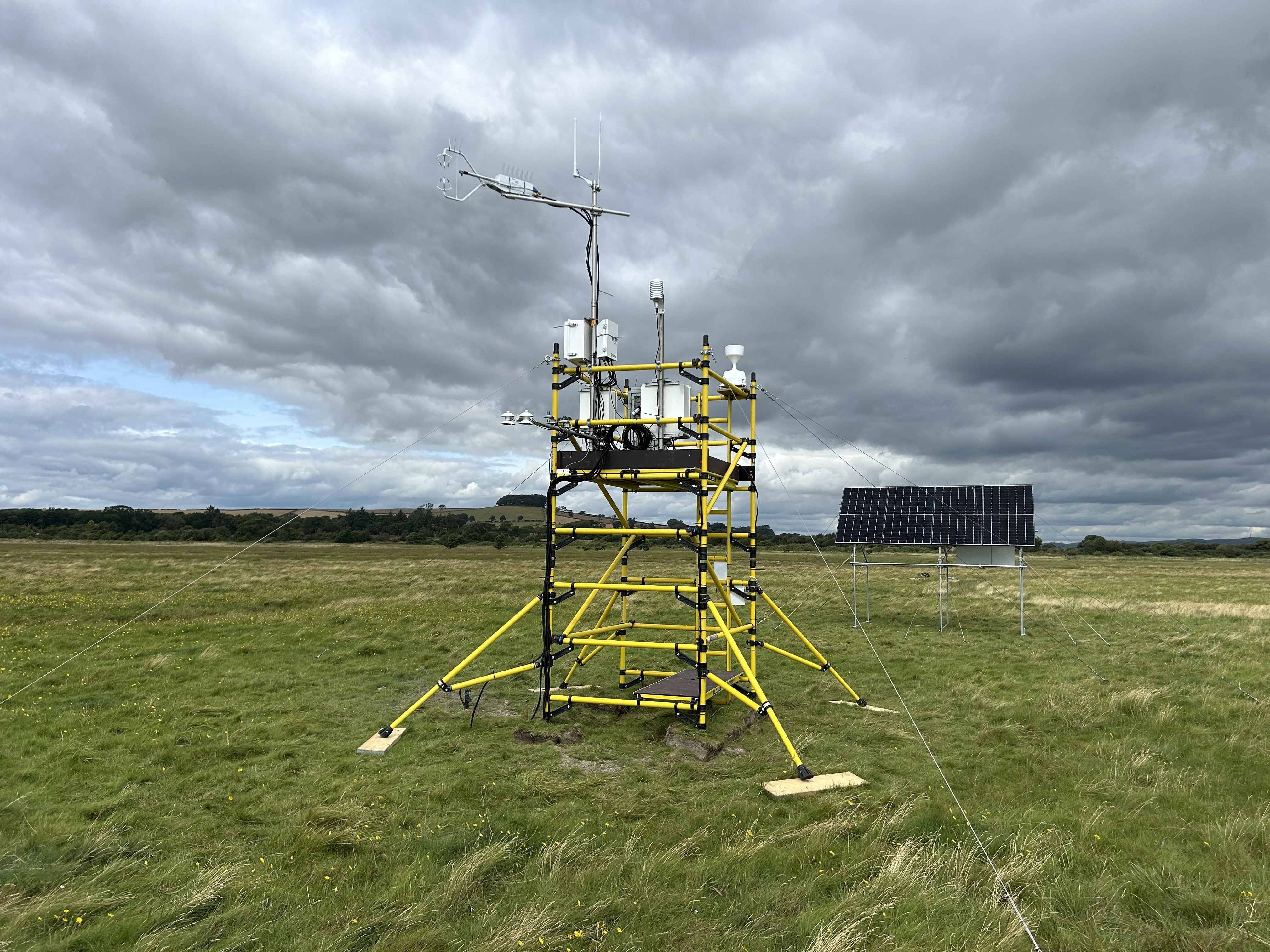
New technology in the Solway Firth will help unlock the carbon storage benefits of Scotland’s largest saltmarsh.
In a first for Scotland, a pioneering gas flux tower has been installed at Caerlaverock in the Solway Firth which will provide scientists with invaluable data into how much carbon is taken out of the atmosphere by this saltmarsh habitat.
Some 85% of UK saltmarshes have been lost since the mid-19th century as land has been reclaimed from the sea for agriculture, development or coastal flood defences, degraded through pollution, or eroded by rising sea levels. When a marsh destabilises and sediment begins to erode, greenhouse gases that are produced within the soil can be released to the atmosphere at enhanced rates.
This project is a partnership between UK Centre for Ecology & Hydrology (UKCEH), Scottish Government, NatureScot and WWF-UK.
Corallie Hunt, Coastal Habitats Adviser for NatureScot said, “The installation of Scotland’s first saltmarsh flux tower on the Solway Firth marks an important milestone for environmental research and delivers on a key priority in Scotland’s Blue Carbon Action Plan. By measuring carbon exchange in real time, it will strengthen our understanding of the carbon storage potential of saltmarshes and the value of protecting and restoring these habitats.”
UKCEH wetland scientist Annette Burden said, “This Solway flux tower is the most northerly addition to a network of flux towers set up around the UK coast. The data collected will aid in understanding the role saltmarsh plays in climate mitigation, provide evidence for saltmarsh inclusion in the UK Greenhouse Gas (GHG) Inventory, which in turn will strengthen calls to safeguard and restore this valuable habitat.
In addition to supporting biodiversity and providing natural flood protection, the plants covering the marshes draw down carbon dioxide through photosynthesis and can also trap carbon-rich sediments in their roots and stems on the incoming tide.
Tom Brook, Ocean Conservation Specialist at WWF, said: “The Solway is an extraordinary place for nature. From thousands of migratory birds that depend on these wetlands to the rare natterjack toad, the saltmarsh supports an incredible variety of wildlife. It’s also working hard for people too – helping to absorb wave energy and reduce the impacts of flooding and storm surges. The data gathered by the tower will help us better understand and champion the value of these remarkable coastal habitats.”
This project has been made possible by funding from Scottish Government, NatureScot and WWF-UK with support from Postcode Lottery players. The tower is a significant step to understanding the role that Scotland’s coastal wetlands play in tackling climate change.
The Solway saltmarsh flux tower is part of the UK Saltmarsh Flux Tower Network - a collaborative, multi-partner network spanning sites from southern England to Scotland. The network is coordinated by UKCEH with funding from Defra, Environment Agency and Natural England and hosted by the RSPB and Essex Wildlife Trust.
Greenhouse gas fluxes vary over space and time so it’s important to have multi-site, long-term monitoring across the UK’s saltmarshes. The project is testament to collaborative working, with many organisations involved to both fund and host the flux towers.
Notes to Editors
Supporting images can be found here.
Contacts
For media requests please contact:
Gill Ormrod – UKCEH Senior External Communications Manager
Tel: 07920 295384
Email: press@ceh.ac.uk
About the UK Centre for Ecology & Hydrology (UKCEH)
The UK Centre for Ecology & Hydrology (UKCEH) is a leading independent research institute dedicated to understanding and transforming how we interact with the natural world. With over 600 researchers, we tackle the urgent environmental challenges of our time, such as climate change and biodiversity loss. Our evidence-based insights empower governments, businesses, and communities to make informed decisions, shaping a future where both nature and people thrive.
www.ceh.ac.uk / ukceh.bsky.social / LinkedIn: UK Centre for Ecology & Hydrology
About NatureScot
NatureScot is Scotland's nature agency. Responding to the twin crises of biodiversity loss and climate change, we work to protect and restore nature by inspiring everyone to value our natural world. Our goal is a nature-rich, net-zero future for Scotland. For more information, visit our website at www.nature.scot.
About WWF
WWF (Worldwide Fund for Nature) is one of the world’s largest independent conservation organisations, active in nearly 100 countries.
Our supporters – more than five million of them – are helping us to restore nature and to tackle the main causes of nature’s decline, particularly the food system and climate change. We’re working to ensure a world with thriving habitats and species, and to change hearts and minds so it becomes unacceptable to overuse our planet’s resources.
WWF. For your world.
For wildlife, for people, for nature.
Find out more about our work, past and present at wwf.org.uk.