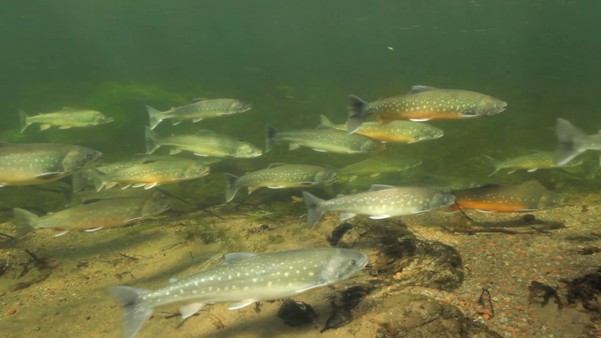
What does the future hold for one of the Lake District’s most iconic fish? As the 2026 findings from the Lake District Charr Recovery & Management (LD-CHARM) project are published, Dr Lori Lawson Handley, Freshwater molecular ecologist at UKCEH, discusses the challenges facing Arctic charr and how a partnership approach is helping to protect this unique Ice Age survivor.
The Arctic charr is one of England's most remarkable freshwater fish. A close relative of salmon and trout, it has survived in the Lake District since the end of the last Ice Age. Today this region supports the last eight remaining populations in England and, together with a few remaining populations in Wales, represents the southern limits of the species’ distribution.
Arctic charr have long been part of the Lake District's natural and cultural heritage (Winfield et al., 2019). Historical records show they were being fished here as early as the 13th century, and since the 1840s, local anglers have used a distinctive plumb-line fishing technique to catch them; a tradition that continues today among a small number of recreational fishers.
The species has also fascinated scientists for decades. In particular, pioneering research by Winifred Frost between the 1940s and 1970s revealed important details about where and when charr spawn, including the existence of separate autumn- and spring-spawning populations in Windermere.
As a cold-water species, Arctic charr are especially vulnerable to environmental change. They thrive in cool, clear lakes and depend on clean, well-oxygenated gravel and rocky lakebeds for successful spawning. Rising water temperatures, nutrient enrichment and the build-up of fine sediments can damage these habitats, reducing the chances of eggs surviving and young fish developing. Charr are also particularly vulnerable to predation at spawning grounds.
Long-term monitoring by UKCEH has documented declines in Arctic charr populations across several Cumbrian lakes since the 1990s. Populations have declined in Windermere, Coniston Water, Ennerdale Water and Haweswater,[LL2.1] while those in Loweswater, Ullswater and Rydal Water are believed to have been lost altogether (Winfield et al., 2010). Concern about the future of Lake District charr populations prompted our team from the UKCEH Aquatic Ecosystems Group, together with colleagues from the Freshwater Biological Association (FBA) and other partners, to investigate the current condition of their Windermere spawning habitats and better understand whether they are still using them.
In previous work in 2017, we surveyed known spawning grounds in Windermere's North Basin using underwater photography and sonar (“hydroacoustics”) to assess lakebed condition. We also collected water samples throughout the autumn spawning season and analysed them for environmental DNA (eDNA); tiny traces of genetic material released by fish into the water. We found that Arctic charr eDNA increased during spawning and declined afterwards, demonstrating that eDNA could provide a powerful, non-invasive way of monitoring spawning activity (Di Muri et al., 2022).
In 2025, we repeated these surveys and expanded them to include sites in Windermere's South Basin and locations historically identified as spring spawning grounds.
Unfortunately, the results were concerning. Key autumn spawning habitats had deteriorated substantially since 2017. At one important spawning site, around 60% of the lakebed had softened - becoming covered by fine sediment and algal growth, reducing the availability of the clean gravel and stones needed for successful egg development (Fig.1).
The eDNA evidence painted a similarly worrying picture. Arctic charr were detected less frequently than in 2017, and the genetic signal was much weaker (Fig. 2). We found no evidence of spawning activity at the spring-spawning sites or in the South Basin. At the same time, we recorded a dramatic increase in the presence of ruffe, an invasive fish species known to prey on charr eggs (Fig. 2). First detected in Windermere through eDNA monitoring in 2015, ruffe were almost absent from our early surveys. By 2025, they had become one of the most frequently detected fish species.
There was, however, a glimmer of hope. We detected Arctic charr eDNA in the River Brathay - just upstream of Windermere - and identified suitable spawning habitat there, suggesting that some fish may be using the river's cleaner, well-oxygenated gravels as an alternative spawning refuge.
Our findings highlight the multiple challenges facing Arctic charr in Windermere, from habitat degradation and climate change to pressures from invasive species. Yet recovery remains possible. With sustained investment, targeted habitat restoration and strong collaboration between researchers, conservation organisations and local stakeholders, there is a genuine opportunity to secure the future of this iconic Ice Age survivor. Through a new Natural England-funded Species Recovery Project, led by our partners at the FBA, we are continuing to build the evidence needed to guide conservation action and help ensure that Arctic charr remain part of the Lake District's natural heritage for generations to come.
For more information, read the full report on the FBA website.
Many thanks to the UKCEH LD-CHARM Team: Iain Hill, Lauren Cook, Glenn Rhodes, Gareth McShane & Steve Thackeray, and to our partners at the FBA, University of the Highlands and Islands, Natural England, Environment Agency, University of Glasgow, Lake District National Park Authority, Institute of Fisheries Management, Echoview and Blueprint Subsea.
References
Di Muri, C., Lawson Handley, L., Bean, C. W., Benucci, M., Harper, L. R., James, B., Li, J., Winfield, I. J., & Hänfling, B. (2022). Spatio‐temporal monitoring of lake fish spawning activity using environmental DNA metabarcoding. Environmental DNA. https://doi.org/10.1002/edn3.343
Winfield, I. J., Hateley, J., Fletcher, J. M., James, J. B., Bean, C. W., & Clabburn, P. (2010). Population trends of Arctic charr (Salvelinus alpinus) in the UK: assessing the evidence for a widespread decline in response to climate change. Hydrobiologia, 650(1), 55–65. https://doi.org/10.1007/s10750-009-0078-1
Winfield, I. J., Berry, R., & Iddon, H. (2019). The cultural importance and international recognition of the Arctic charr Salvelinus alpinus populations of Windermere, UK. Hydrobiologia, 840(1), 11–19. https://doi.org/10.1007/s10750-018-3814-6
