Available translations: English

Kickstart Your Career in Environmental Research – Apply for an Internship! 

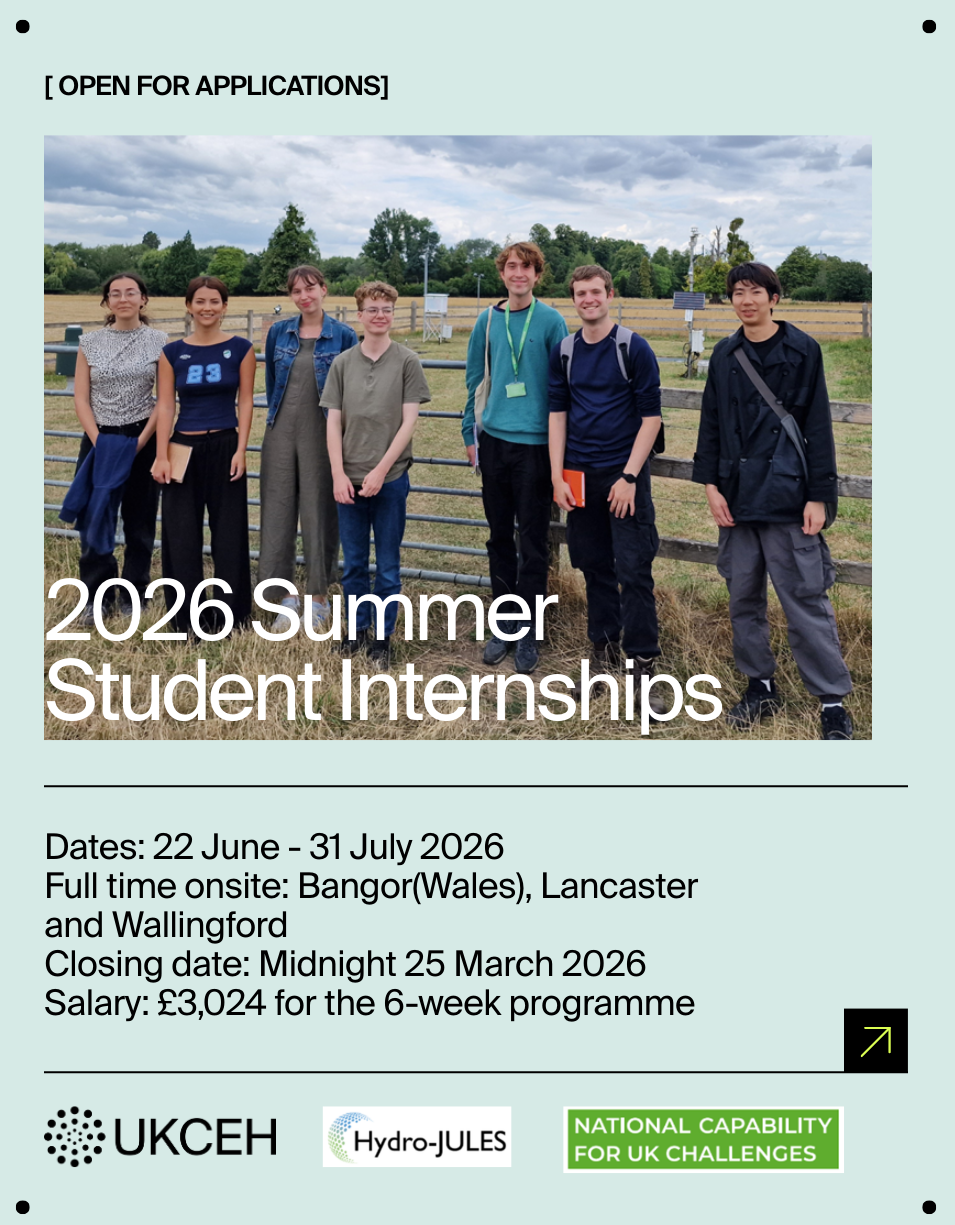
We are excited to offer four new internship positions as part of the UKCEH National Capability for UK Challenges (NC-UK) programme for 2026!  

This is a fantastic opportunity to gain hands-on experience in environmental science and applied research. You’ll develop valuable skills, deepen your knowledge, and contribute to real-world projects that support the environmental research community. 

NC-UK internships are available at our  Lancaster, Bangor sites. Each internship is different, and you are welcome to apply for more than one. 

  • Full-time (37 hours per week)
  • Internship dates are the 22 June – 7 August 2026 
  • Location is either Lancaster and Bangor (please check individual project to confirm the location)
  • Salary allowance: £3,024.00 (before deductions) for the 6-week programme
  • Accommodation is not provided. Participants will need to arrange and fund their own accommodation and living costs
  • Application deadline is the 25 March 2026
  • Interviews will take place between the 20 April and 4 May 2026

Why Apply? 

  • To gain invaluable experience in environmental research  
  • To work on meaningful projects with real-world impact  
  • To develop skills that support both academic and professional growth  
  • To build confidence working alongside experienced scientists and research teams  
  • To strengthen your CV and gain insight into careers in environmental science 

Eligibility Criteria 

  • You must be available at the appropriate site for the full 6-week duration. Hybrid working will not be allowed.
  • You must be a current undergraduate or postgraduate (including PhD) student and returning to university following the placement  – please check individual project requirements. 
  • You must be studying a relevant degree.
  • You must have the legal right to work in the UK throughout the placement duration. Unfortunately, we are unable to offer visa sponsorship for this role, and this does not qualify for endorsement to support a Global Talent Visa application. 
  • You must be comfortable working independently with strong communication and interpersonal skills. 
  • You must be able to act as a strong, collaborative team player who is confident giving and receiving feedback. 

Successful  applicants must also agree to the following: 

  • To provide a one-page report to their supervisor describing the visit and its accomplishments, plus a short testimonial within 30 days of completion of the visit. 
  • To agree to appear in publicity and promotion materials for UKCEH. 
  • To agree to produce and present a poster, and / or give a presentation at a NC-UK event. 
  • To acknowledge the support of NC-UK funds in any publications or presentations arising from the visit. 

Project overviews are provided below, and the full job description including the skillset required for each proposal can be found in the attached documents.

The Projects

Project 1 - Uncovering and minimising barriers to digital research infrastructure in environmental science (Lancaster) 

Supervisors: 

Kelly Widdicks (Lead) - UKCEH
Taylor Butler-Eldridge – UKCEH
Emily Winter – Lancaster University

Digital research infrastructure (DRI) developed under the NC-UK programme aims to support a variety of diverse stakeholders with wide-ranging digital skillsets for their environmental science insights and decisions. In Computer Science, it is known that without responsible design and inclusive participatory engagement through co-design processes, digital technologies can be designed with biases embedded that create barriers to specific individuals and groups in engaging with such technologies. 

Some of these issues have begun to transpire through the NC-UK programme’s DRI developments. Recognising this issue, the project will investigate and evaluate potential inclusivity and accessibility barriers for both digital research infrastructure (DRI) for environmental science, and the participatory engagement or co-design activities for developing the DRI. Drawing on lessons learned and best practices from the domains of digital and design, the internship will help shape the design and engagement mechanisms for NC-UK WP2 to improve inclusivity and accessibility moving forward.  

The project will take a two-phase approach: 1) the candidate will first conduct a scoping review of the literature on digital inclusivity and accessibility within science and research, reading key publications and outputs from Human-Computer Interaction, Design and Computer Science, alongside closely relevant works from related disciplines such as the social and environmental sciences; and 2) in uncovering known biases and barriers, the candidate will then evaluate DRI developments and engagement activities to offer directions in the programme for more inclusive and accessible outcomes surrounding DRI in environmental science. This will support the NC-UK programme’s ambitions in enhancing EEDI (Equality, Equity, Inclusion and Diversity) in its community-driven outputs and initiatives. 

Key tasks include:

Scoping review (Weeks 1–3)

  • Carry out a high-level scoping review of recent literature across human–computer interaction, social science and environmental science. level scoping review of recent literature across human–computer interaction, social science and environmental science.
  • Identify barriers in digital technology and co design activities.
  • Select a focused EEDI theme based on existing knowledge and the intern’s interests.

Building the evidence base (Weeks 3–4)

  • Pull together best practices for designing digital technologies and understanding the social contexts around them.
  • Explore inclusive engagement approaches for co designing Digital Research Infrastructure (DRI).

Applying insights (Weeks 4–5)

  • Review current DRI platforms in development and existing co design mechanisms (e.g., Community Conversations).
  • Assess them against barriers highlighted in the literature.
  • Recommend adjustments aligned with EEDI best practice.

Sharing findings (Week 6)

  • Deliver a presentation of key insights to the NC UK WP2 team and other interested colleagues, including CEEDS (Centre of Excellence in Environmental Data Science — a UKCEH and Lancaster University collaboration).
  • Ensure learning is fed back into the wider programme and ongoing DRI development.
  • Optional wider contribution
  • Create a poster or work InProgress paper for a relevant conference or journal (e.g., CHI) to showcase progress and outcomes throughout the internship. in progress paper for a relevant conference or journal (e.g., CHI) to showcase progress and outcomes throughout the internship.

Project 2 - Environmental data visualisation (Lancaster) 

Project 2 - Environmental data visualisation (Lancaster) 

Supervisors

Jacky Chaplow (Lead) - UKCEH
Erin Corbett - JNCC
Emily Forbes - JNCC


The UK Centre for Ecology & Hydrology (UKCEH) is working with the Joint Nature Conservation Committee (JNCC) on a Defra funded data visualisation project. This internship offers the opportunity to contribute to the System-Level Indicators project, which aims to integrate and visualise diverse environmental datasets including chemical pollution, biodiversity and climate change amongst others. 

Interns will:

  • Investigate options for visualising complex data integrations across multiple ecological and environmental domains. 
  • Explore visualisations that capture interactions between climate, land use, biodiversity, and ecosystem services. 
  • Assess the suitability of different visualisation techniques for communicating to stakeholders


Key tasks include:

  • Review existing indicator frameworks and visualisation methods. 
  • Work with UKCEH researchers to identify priority datasets for integration. 
  • Develop and present visualisation prototypes to demonstrate potential approaches. 
  • Document findings and provide recommendations for future integration into the tool.

Project 3 - Hydrogeochemical Sampling and Data Investigation at UKCEH’s Plynlimon Research Catchments (Bangor) 

Supervisors

Maud van Soest (Lead) - UKCEH
Jade Hatton - JNCC
Eleanor Fitos - JNCC

This six-week summer internship focuses on the collection, processing, and analysis of hydrogeochemical data from the Plynlimon catchments in mid-Wales. The intern will contribute directly to the UK Centre for Ecology & Hydrology’s long-term environmental monitoring programme by supporting routine sampling, assessing data quality, and undertaking exploratory analysis of hydrogeochemical data to identify trends and environmental drivers. The project also offers strong cross-programme links with the Floods and Droughts Research Infrastructure (FDRI). The intern will be able to draw on the recently published Plynlimon Hydrology (1968-2010) dataset produced by the FDRI team, as well as the Severn Trap hydrology data now streamed to the FDRI data portal via telemetry. Integrating these datasets with hydrochemical observations will enhance the contextual understanding of catchment behaviour and support more robust interpretation of long-term environmental change. Overall, the internship blends fieldwork, laboratory work, and data analysis, offering a holistic introduction to catchment-scale hydrology and biogeochemistry.

Key tasks include:

  •  Assist with routine hydrogeochemical sampling at Plynlimon during a field visit in early July 
  • Prepare and process environmental samples in the laboratory 
  • Carry out data entry, quality checks and metadata documentation 
  • Perform exploratory data analysis using statistical and visualisation tools (e.g., R) 
  • Compare recent measurements with long-term term datasets to spot anomalies or emerging trends 
  • Contribute to internal reporting, including short written summaries and supporting figures 
  • Take part in regular team meetings and discussions

Project 3 - Hydrogeochemical Sampling and Data Investigation at UKCEH’s Plynlimon Research Catchments (Bangor) 

Project 4 - Fine-tuning a state-of-the-art geospatial foundation model for UK land cover classification (Lancaster) 

Supervisors

Jeremy Carter - UKCEH
Clare Rowland – UKCEH
Michael Hollaway - UKCEH

This pilot project explores new approaches in Earth observation by testing whether the state-of-the-art Prithvi EO-2.0 geospatial foundation model can be fine-tuned to improve the production of the UKCEH Land Cover Map (LCM). At present, the UK LCM is created using supervised learning methods (specifically random forests) that depend heavily on high-quality labelled training data. Much of this data is inherited from previous LCM versions, which works well for existing land-cover classes. However, when new analytical needs arise, such as adding extra classes, there is a significant time and resource cost involved in generating sufficient new labelled data. 

To address this, the project will explore transfer learning by fine-tuning the Prithvi EO-2.0 model, which has been pre-trained using self-supervised learning on very large volumes of multi-spectral satellite imagery by NASA and IBM. This pre-training allows the model to learn a compact, general representation of satellite data that captures important patterns while reducing noise. These learned representations can then be reused for downstream tasks such as land-cover classification, reducing the need for labelled data while improving efficiency and expected performance. This approach also makes it easier to adapt and extend the workflow to new use cases, including the exploration of ultra-high-resolution classification. 

The intern will build on existing tools, frameworks and tutorial resources to validate performance against current LCM workflows using a test region (e.g. the Lake District). The findings will help assess whether geospatial foundation models can extend and accelerate future LCM production and support NCUK’s wider ambitions for rapid, nationalscale environmental monitoring. The work will also contribute a reproducible notebook to the NCUK data science toolbox. 

Key tasks include:

Run the Prithvi EO 2.0 model and demonstrate its ability to reconstruct masked satellite images. 

  • Test an existing fine tuned Prithvi model (e.g. flood detection) on example imagery. 
  • Download and prepare a Sentinel 2 dataset for a selected UK test area (e.g. the Lake District) and assess the model’s reconstruction performance. 
  • Access the matching UKCEH Land Cover Map (LCM) data for the test region. 
  • Fine tune the Prithvi model for land cover classification using the LCM subset. 
  • Create training and test datasets, run experiments, and evaluate model performance against current methods. 
  • Identify any bottlenecks or limitations and make recommendations for future work. 
  • Work closely with the Digital Research and Land Use teams, using existing scripts and workflows. 
  • Adapt tasks as needed during the pilot study based on progress and findings.
     

How to Apply

1. Check you’re eligible

  • You must be a current undergraduate or postgraduate (including PhD) and returning to university following the placement  
  • You must be able to work full‑time (37 hours/week), at the relevant site for the 6‑week summer placement. Hybrid working is not allowed.
  • Hold the legal right to work in the UK throughout the placement duration. Unfortunately, we are unable to offer visa sponsorship for this role, and this does not qualify for endorsement to support a Global Talent Visa application. 

2. Prepare three documents

  • Provide a support letter from your tutor/supervisor approving the internship.
  • Write a tailored covering letter saying why you want the internship and which project(s) you would like to apply to quoting the project number and full project title.
  • Provide a short CV with your education and experience. 

3. Choose your project

  • Project 1 - Uncovering and minimising barriers to digital research infrastructure in environmental science (Lancaster) 
  • Project 2 - Environmental data visualisation (Lancaster)
  • Project 3 - Hydrogeochemical Sampling and Data Investigation at UKCEH’s Plynlimon Research Catchments (Bangor)
  • Project 4 - Fine-tuning a state-of-the-art geospatial foundation model for UK land cover classification (Lancaster)

4. Submit online

Don’t miss out on this exciting opportunity to make a difference! – APPLY NOW! 

You will carry out work for UKCEH under a contract of services agreement via Hays PLC (Company Number 02150950). You will be paid weekly by Hays PLC by submitting a timesheet to your UKCEH Line Manager.