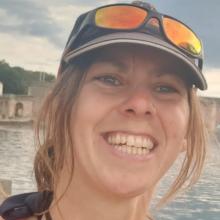
Professional summary
Anna Belcher is a catchment biogeochemist working in the Freshwater restoration and sustainability team. She is an observational scientist, making field measurements to understand nutrient and carbon cycling in aquatic systems. In particular she is interested in the land-sea interface as well as greenhouse gas emissions/sinks in terrestrial and aquatic environments.
Anna completed her undergraduate masters degree in Oceanography at the University of Southampton, with a year at the University of Washington, Seattle. After 2 years working an an oceanographic surveyor, she returned to the National Oceanography Centre in Southampton where she completed a PhD on particulate organic carbon cycling in the Southern Ocean. Following this Anna worked as a post-doc with British Antarctic Survey for 5 years, looking at respiration of mesopelagic fish, carbon cycling in the ocean interior, and the role of krill in biogeochemical cycling.
In 2023, Anna worked in the greenhouse gas flux team at Forest Research, supporting eddy covariance, soil respiration and met station measurements, supporting the collection of data to investigate the role of UK managed forests on UK carbon inventories.
Anna moved to UKCEH in 2024 to work with the freshwater team and is currently involved in a number of projects including, BIOPOLE (BIOPOLE - Biopole), MERLIN (MERLIN | UK Centre for Ecology & Hydrology (ceh.ac.uk)), GHG Aqua (GHG Aqua | UK Centre for Ecology & Hydrology (ceh.ac.uk)) and a project with Scottish water looking at water quality with depth in reservoirs.
Ramondenc, S., Lampitt, R.S., Norrbin, F. M., Belcher, A., von Appen, W. J., Iversen, M.H., (2025). Presence of two eddies in close proximity drives large spatial and temporal heterogeneity in the euphotic zone. Progress in Oceanography, 235 103476. https://doi.org/10.1016/j.pocean.2025.103476.
Major, W., ...Belcher, A., ...Sanders, R. (2024) Active and passive organic carbon fluxes during a bloom in the Southern Ocean (South Georgia). Scientific Data 11. https://doi.org/10.1038/s41597-024-04151-w.
Cavan, E., Mackay, N., Atkinson, A., Belcher, A., Hill, S. (2024) Antarctic krill sequester similar amounts of carbon to key coastal blue carbon habitats, Nature communications, 15:7842.
Savineau et al. (2024) Investigating the physiological ecology of mesopelagic zooplankton in the Scotia Sea (Southern Ocean) using lipid and stable isotope signatures, Deep Sea Research Part I, 208, 104317, https://doi.org/10.1016/j.dsr.2024.104317.
Hill et al. (2024) Observing change in pelagic animals as sampling methods shift: the case of Antarctic krill, Frontiers in Marine Science, 11, https://doi.org/10.3389/fmars.2024.1307402.
Tarling et al. (2022) Carbon and lipid content of the copepod Calanus finmarchicus entering diapause in the Fram Strait and their contribution to the boreal and Arctic lipid pump, Frontiers, 9 (926462), doi:10.3389/fmars.2022.926462.
Tarling et al. (2022) Can a key boreal Calanus copepod species now complete its life-cycle in the Arctic? Evidence and implications for Arctic food-webs, AMBIO, https://doi.org/10.1007/s13280-021-01667-y.
Alewijnse, S., Stowasser, G., Saunders, R., Belcher, A., Crimmen, O., Cooper, N., Trueman, C. (2021) Otolith-derived field metabolic rates of myctophids (family Myctophidae) from the Scotia Sea (Southern Ocean). Marine Ecology Progress Series, 675, 113-131.
Bohleber et al. (2020) Successful practice in early career networks: insights from the polar sciences, Advances in Geosciences, 53, 1-14.
Cavan. E., Belcher, A., et al. (2019) The importance of Antarctic krill in biogeochemical cycles, Nature Communications, 10 (4742), 10.1038/s41467-019-12668-7
Cavan, E., Belcher, A., Ratnarajah, L., (2019) How Antarctic krill fertilise the oceans and even store carbon – all with their poo, The Conversation, 125362.
Belcher, A., C. Manno, S. A. Thorpe, G. A. Tarling. (2018) Acantharian cysts: high occurrence in the bathypelagic of the Scotia Sea, Southern Ocean, Marine Biology, 165: 117 .
Baker, C. A., Belcher, A., Buzzard, S., Mayers, K., Dayal, A. (2018) Polar science communication: From north to south, Open access government, February 2018.
Belcher, A., G. A. Tarling, C. Manno, P. Ward, A. Atkinson, S. A. Henson, R. Sanders (2017) The potential role of Antarctic krill faecal pellets in efficient carbon export at the marginal ice zone of the South Orkney Islands in Spring, Polar Biology, DOI: 10.1007/s00300-017-2118-z.
Fassbender, A. J. et al. (2017) Perspectives on Chemical Oceanography in a changing environment: Participants of the COME ABOARD Meeting examine the field in the context of 40 years of DISCO, Marine Chemistry, 196, 181-190.
Baker, C. A., S. A. Henson, E. Cavan, S. Giering, A. Yool, M. Gehlen, A. Belcher, J. Riley, H.E.K. Smith, R. Sanders (2017) Slow Sinking Particulate Organic Carbon in the Atlantic Ocean: magnitude, flux and potential controls, Global Biogeochemical Cycles, 31(7), 1051-1065
Cavan, E., S. A. Henson, A. Belcher, R. Sanders (2017) Role of zooplankton in determining the efficiency of the biological carbon pump, Biogeosciences, 14, 177-186
Belcher, A., M. Iversen, C. Manno, S. A. Henson, G. A. Tarling, R. Sanders (2016) The role of particle associated microbes in remineralisation of faecal pellets in the upper mesopelagic of the Scotia Sea, Antarctica, Limnology and Oceanography, 61 (3), 1049-1064, DOI: 10.1002/lno.10269