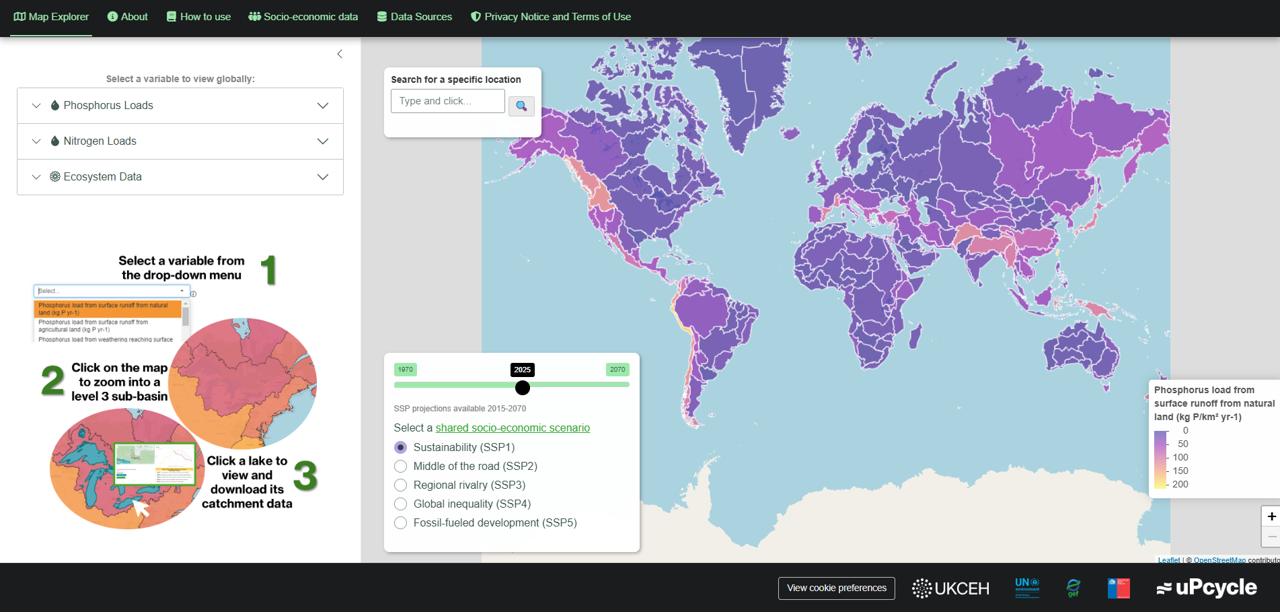
A new, interactive global map has been launched to help people understand how pollution and climate change are affecting lakes around the world.
The interactive platform, known as the Global Lakes Explorer, helps scientists, policymakers, educators, and the public to explore where nutrients such as phosphorus and nitrogen are entering lakes and how this pollution may change in the future.
The tool was developed through an international initiative funded by the Global Environment Facility (GEF) and the United Nations Environment Programme (UNEP) and led by the UK Centre for Ecology & Hydrology (UKCEH) in collaboration with global research partners.
Lakes are essential for people and nature. They provide drinking water, support wildlife, regulate the climate, and sustain fisheries and livelihoods. However, many lakes are increasingly threatened by pollution and biodiversity in freshwater is declining faster than in any other ecosystem on Earth, making lakes and rivers some of the most threatened environments globally.
One of the greatest pressures comes from excess nutrients, especially phosphorus and nitrogen. These are widely used in fertilisers and are essential for food production. But when too many nutrients run off the land or enter rivers and lakes through wastewater discharges, they can cause serious environmental and economic damage.
High nutrient levels can trigger ‘algal blooms’, where blue-green bacteria grow rapidly and cover the surface of the water. These blooms can be toxic to animals and humans and can create de-oxygenated ‘dead zones’ that harm fish and other wildlife.
Nutrient pollution is an increasing concern in many parts of the world, including in the UK. Lough Neagh in Northern Ireland, the largest freshwater lake in the British Isles, has recently experienced severe algal blooms linked to excess nutrients entering the water.
Large lakes such as Lake Victoria, Lake Tanganyika and Lake Malawi in East Africa, the ancient Lake Baikal in Siberia, Lake Toba in Indonesia and smaller freshwater systems in Patagonia are globally recognised for their remarkable aquatic biodiversity.
Some of these lakes have persisted for millions of years, allowing unique species to evolve that exist nowhere else on Earth. But increasing pollution and a rapidly changing climate now threaten these ecosystems, highlighting the urgent need to protect freshwater habitats.
The Global Lakes Explorer brings together large amounts of environmental data to help reveal where these risks are greatest, and how changes in societal behaviour will shape the future. The platform combines open datasets covering agriculture, wastewater, aquaculture and other human activities that influence nutrient pollution. It displays information for more than 40,000 of the world’s biggest lake catchments worldwide, allowing users to explore patterns at local, national and global scales.
The modelled nutrient data have been validated using measured values from the UKCEH long-term monitoring site at Loch Leven, Scotland, UK, and data from a detailed assessment of the phosphorus inputs to Lake Villarrica, Chile, provided by partners on this project.
UKCEH Data Scientist Philip Taylor, development team lead, said, “Blind spots have long been a problem in environmental monitoring, leaving biodiversity and societies exposed to pollution. This new map harnesses data from remote sensing and predictive modelling to shed light on these risks. The tool is already being used by countries to better understand how exposed their lakes are to these threats and what can be done to protect them.”
“Until now, data on nutrient emissions have been fragmented and hard to access in a meaningful way, which has hindered progress in tackling pollution. The Global Lakes Explorer seeks to bridge these gaps,” said Dr Elise Gallois, a post-doctoral researcher at the University of Edinburgh and UKCEH, and part of the development team for the tool.
She added: “Over the past two years, we have worked with many fantastic scientists around the world to build the Global Lakes Explorer. Our aim was to produce a tool that would help identify freshwater ecosystems in urgent need of protection, for people and for biodiversity.”
“The strength of the Global Lakes Explorer lies in its interoperability, and data sharing capability,” said Ivar Ledezma of UNEP, Bolivia.
“By bringing together lake data from multiple sources into a unified platform, it allows diverse environmental datasets to work together in ways that were previously difficult. This helps bridge science and policy by transforming complex information into practical knowledge that enables decision-makers to respond more effectively to pressures on lake ecosystems and freshwater biodiversity worldwide.”
The Global Lakes Explorer is freely available online.
– Ends –
Notes for Editors
The Global Lakes Explorer tool is available at connect-apps.ceh.ac.uk/global-lakes/.
UKCEH has created a video tutorial so you can make the most of the tool.
The Global Lakes Explorer has been produced as part of the uPcycle project, led by UKCEH and the Chilean Ministry of Environment, which is championing innovations in the re-use and recycling of nutrients.
Media enquiries
For an interview with a scientist or further information about the portal, please contact the UKCEH press office via cehpress@ceh.ac.uk or 44 (0)7920 295384.
About the UK Centre for Ecology & Hydrology (UKCEH)
The UK Centre for Ecology & Hydrology (UKCEH) is a leading independent research institute dedicated to understanding and transforming how we interact with the natural world. With over 600 researchers, we tackle the urgent environmental challenges of our time, such as climate change and biodiversity loss. Our evidence-based insights empower governments, businesses, and communities to make informed decisions, shaping a future where both nature and people thrive.
www.ceh.ac.uk / ukceh.bsky.social / LinkedIn: UK Centre for Ecology & Hydrology