
-
UKCEH monitoring shows surface temperatures have risen 1.5C since 1940s
-
Increased warming and risk of algal blooms threaten wildlife of iconic lake
-
TV presenter Helen Skelton joins scientists to take part in day of fieldwork
Long-term monitoring data collected by the UK Centre for Ecology & Hydrology (UKCEH) show that surface temperatures in Windermere, the largest lake in England, have warmed by 1.5 degrees in the last 80 years.
“We’re seeing the clearest signals yet that the Cumbrian lakes are heating up,” says Dr Stephen Thackeray, UKCEH lake ecologist who coordinates long-term, frequent monitoring in the Lake District. “Because we’ve been tracking Windermere’s temperature for over 80 years, we can say with confidence that 2025 wasn’t just an unusually warm year; it’s part of a long-term shift that requires our attention and action.”
The UKCEH observations in the region’s lakes show surface waters are warming, while oxygen concentrations are decreasing at depth. These changing conditions alter habitats for wildlife and can increase the likelihood of cyanobacterial blooms which reduce water quality, affect aquatic wildlife, pose a risk to people and pets, and can impact recreational activities, local businesses and tourism.
Lakes are vitally important ecosystems that provide clean drinking water, support jobs and local economies, sustain biodiversity and fisheries, and offer opportunities for recreation, wellbeing and creative inspiration. They also play a key role in climate regulation and nutrient cycling, making them essential for both people and nature. However, they are fragile and under pressure from climate change, pollution like agricultural runoff and sewage inputs, and invasive non-native species.
UKCEH long-term monitoring data reveal these combined environmental pressures have, for example, contributed to dramatic declines of Arctic charr - a cold-water species synonymous with Windermere - in recent decades.
UKCEH is also using cutting edge technologies such as environmental DNA (eDNA) analysis and underwater acoustic equipment to understand how environmental pressures are affecting Arctic charr populations, and wider biodiversity in the lake, adding to its legacy of long-term fish population monitoring to improve understanding of lake change.
Preliminary results in collaborative work with the Freshwater Biological Association indicate a continued decline in Arctic charr and the condition of their habitat, together with an increase in the population of ruffe, a fish species that is not native in northern England, but was first detected in Windermere with eDNA in 2015 and is known to feed on eggs of other fish species and compete with them for food.
“Lakes like Windermere are sentinels of change, like canaries in the coal mine,” says Dr Thackeray. “But their story can sometimes be oversimplified, with focus on single pressures that don’t reflect the full range of environmental challenges they face. They are teeming with life, yet respond quickly to climate change, extreme weather, pollution, like sewage inputs, and land use pressures”.
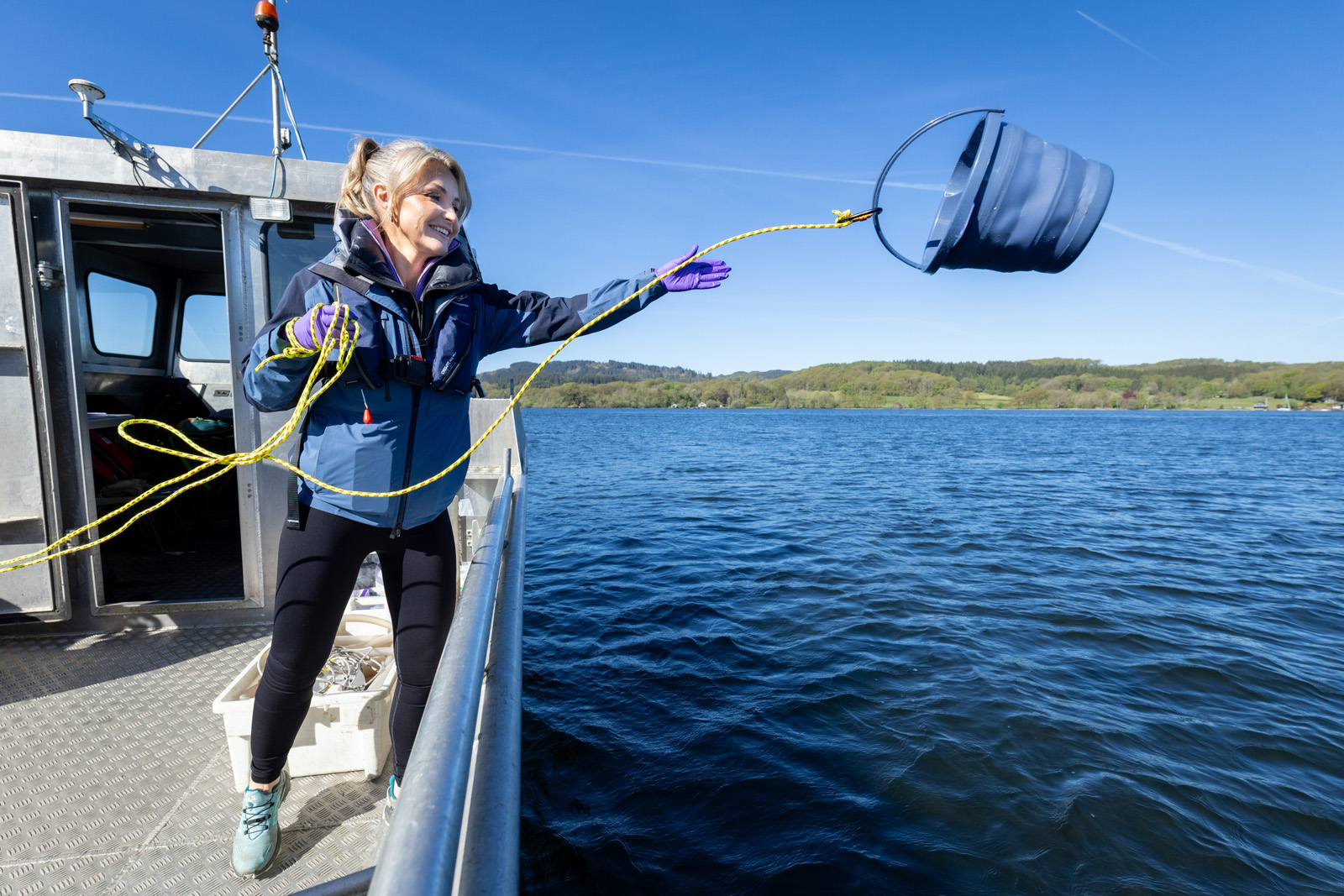
To make its research into rising temperatures and lake ecology more accessible, UKCEH has, for the first time, invited social media content creators, including Cumbrian TV presenter Helen Skelton, to experience its science first-hand at Windermere. Participants undertook real fieldwork, collecting samples, exploring temperature, algal blooms and wildlife, and analysed data in a pop-up lab on shore.
Helen Skelton said of the experience: “Having this kind of hands-on access to lake science has been amazing. As someone who loves Cumbria, learning what’s happening beneath the surface of Windermere, and why it matters, really brings it home.
“Without long-term data, we simply wouldn’t know how the lake is changing. It’s made me realise how important it is to keep that research going, but also that individuals can play a role too - whether that’s reporting via the Bloomin Algae app or just being more aware. It gives me hope that, together, we can protect Windermere’s future.”
UKCEH research is addressing the major challenge of forecasting how lake ecosystems will respond to different future climate scenarios in the future and understanding climate impacts that have already occurred.
Dr Thackeray adds: “Climate, human activity, land use and species populations have all changed. As the climate warms, we’re seeing conditions that favour algal blooms more often: higher water temperatures, longer dry spells, and intense rainfall washing nutrients into lakes. At the same time, changes in water chemistry can release historic pollution from sediments, adding to the problem.
“According to global-scale and European-scale studies lakes have, on average, been warming in recent decades. Larger UK lakes and reservoirs featured in those studies on average also showed a warming trend, yet there’s currently no single, coordinated UK-wide lake temperature dataset. This does represent a real gap in our ability to assess changes at the national scale, so continued research is essential, alongside collective action from communities, visitors, the farming sector and industries to reduce pollution and safeguard Windermere as a resilient lake for generations to come.”
-ENDS-
Media enquiries
For further information or an interview with Dr. Stephen Thackeray, please contact UKCEH Press Office +44 (0)7920 295384 or email cehpress@ceh.ac.uk.
Image from the day of fieldwork with Helen Skelton available here.
Download images and b-roll video of Windermere here.
The 2025 dataset from which this summary of findings has been drawn will be available from the Environmental Information Data Centre (EIDC) at 0800am Friday 1 May.
• Blelham Tarn data
• Esthwaite Water data
• Windermere North Basin data
• Windermere South Basin data
Notes to editors
About cyanobacteria
Under certain environmental conditions, some cyanobacteria, commonly known as blue-green algae, can:
• Produce toxins that pose risks to pets and people.
• Restrict growth of aquatic plants, reducing habitat and food for freshwater species.
• Reduce oxygen concentrations (when blooms die off), posing a risk to fish.
This results in disruption to recreation and impacts on local businesses and tourism. People can submit sightings and photos of suspected blooms via UKCEH’s Bloomin Algae app and our experts confirm if they are cyanobacteria or not. However, there is no way to tell which blooms are toxic by the naked eye.
About eDNA (Environmental DNA)
All organisms leave traces of their DNA as they move through their environment. Fish, for example, shed scales and release mucous, waste and gametes (eggs and sperm) into the water they live in. This environmental DNA (eDNA) can be analysed by collecting water samples and sequencing the DNA that they contain. UKCEH and collaborators pioneered this method for monitoring lake-fish communities in work carried out on Windermere in 2015-2017. More information about eDNA can be found here.
About Arctic charr
Catch and release data from UKCEH’s long-term fish monitoring has demonstrated a substantial decrease in Windermere Arctic charr populations over the last 50 or so years (or since the 1970s). UKCEH are currently gathering evidence on the status of Arctic charr and condition of their spawning habitat in Windermere as part of the Lake District Charr Recovery and Management Project (LD-CHARM), led by the Freshwater Biological Association. Preliminary data indicates a worrying decline in both the habitat condition and the strength of eDNA signal on spawning grounds. This information is crucially important to inform conservation actions for both Arctic charr and their habitat. More information about Arctic charr can be found here.
About UKCEH
The UK Centre for Ecology & Hydrology (UKCEH) is a leading independent research institute dedicated to understanding and transforming how we interact with the natural world. With over 600 researchers, we tackle the urgent environmental challenges of our time, such as climate change and biodiversity loss. Our evidence-based insights empower governments, businesses, and communities to make informed decisions, shaping a future where both nature and people thrive. www.ceh.ac.uk
About the Cumbrian Lakes Monitoring Platform
Since 1989 UKCEH has led one of the world’s longest-running lake monitoring programmes, started by the Freshwater Biological Association (FBA) in the 1940s, with core funding from UK Research and Innovation. Currently, four lake basins (North and South basins of Windermere, Esthwaite Water, Blelham Tarn) are visited every fortnight and a range of physical, chemical and biological conditions are recorded. Further information about the Cumbrian Lakes Monitoring Platform can be found here.
About NC-UK
The data collected at Windermere is part of a UK-wide environmental monitoring programme known as National Capability for UK Challenges funded by the UK Government, linking lake science with research on climate change, pollution, biodiversity and land use. These long-term datasets support predictive models to improve decision making, inform environmental policy and nature recovery targets, and help society adapt to environmental pressures. Further information about NC-UK can be found here.