
Dr Carolynne Lord, Senior Digital Sociologist, and Dr Kelly Widdicks, Lead for Digital Innovation at UKCEH, reflect on the Environment Analyst’s Managing the Environmental Impacts of Data Centres conference...
Energy and water use are often at the centre of the conversation among the public and media about the sustainability of data centres - and these concerns are important and well grounded. However, discussions at the conference highlighted that these are only part of a much broader and more interconnected picture.
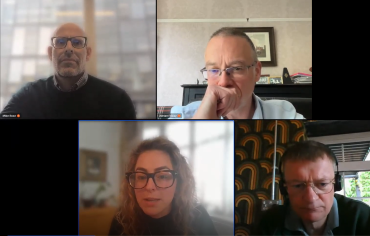
Insights during a session on why whole-systems evidence matters (watch on demand here) pointed consistently towards one central idea: data centres need to be understood as part of wider systems, not in isolation.
Chaired by Carolynne Lord, the panel comprised:
- Jon Saltmarsh, Chief Technology Officer, Energy Systems Catapult
- Prof Adrian Friday, Professor of Computing and Sustainability, Lancaster University
- Mike Rose, CEO, UK Water Industry Research (UKWIR)
They highlighted that data centres are embedded within a broader network of environmental and societal systems, which brings additional considerations:
- Material demand, including the growing need for silicon and hardware manufacturing
- Heat generation, and how it is managed or potentially reused
- Land use and infrastructure pressures, including interactions with housing and local services
- Seasonal variability, where peak conditions (such as heatwaves or dry periods) can place sudden strain on systems
Mike Rose highlighted the importance of looking beyond averages. Systems that appear robust under typical conditions may face significant challenges during periods of peak demand or constrained supply, particularly at a local scale.
Rebound risk
Another important dimension discussed was the rebound effect, where improvements in efficiency can lead to increased overall demand.
As Carolynne Lord raised, in practice, as digital technologies become more efficient, accessible and embedded in everyday life, demand for computation can grow rapidly. This can offset, or even outweigh, expected environmental gains, making it important to consider total system impact over time, not just efficiency improvements in isolation.
Without greater emphasis on longevity and durability, this dynamic risks embedding higher levels of resource use over the long term.
Identifying opportunities
Alongside these challenges, the discussion also highlighted a range of opportunities. For example, as Jon Saltmarsh outlined, the heat generated by data centres, often treated as waste, can instead be captured and reused within district heating networks.
Taking advantage of these opportunities requires a whole-systems approach across the full lifecycle of data centres which includes:
- Design and construction, considering impacts on other infrastructures, communities and the environment
- Day-to-day operations, including cooling and energy use
- Supply chains and manufacturing processes
- Longer-term reuse, upgrade or decommissioning considerations
This kind of integration allows energy that would otherwise be lost to support other parts of the system, helping to reduce overall demand and creating more efficient, interconnected infrastructure.
Crucially, this also involves understanding how data centres interact with other systems and services, rather than viewing them as standalone assets. As highlighted by Adrian Friday, longevity is an important factor and yet, often overlooked. For example, digital and computation devices should be made to last to minimise the demand for specific materials which will be in high demand.
Importance of collaboration
A consistent message across the panel was that addressing these challenges requires collaboration across disciplines and sectors.
From engineers and planners to environmental scientists and policymakers, multiple perspectives are needed to:
- Understand complex system interactions
- Develop and implement effective solutions
- Support monitoring, governance and regulation
This kind of collaboration will be key to translating whole-systems thinking into practical, real-world outcomes.
Key takeaways
Overall, the main messages from the session were:
- Sustainability goes beyond power and water: data centres affect materials, land use, heat and wider infrastructure systems.
- Efficiency alone isn’t enough: rebound effects mean demand can grow alongside improvements.
- Whole-systems thinking is essential: impacts and opportunities span lifecycle stages and sectors.
- Longevity matters: sharing and keeping current computational infrastructure for longer helps reduce impacts.
- Integration creates opportunity: for example, reusing waste heat in district heating networks.
So, what next?
Taken together, the discussion highlighted the need to move beyond narrow or siloed approaches to sustainability. Focusing on individual metrics such as energy or water in isolation, risks overlooking the wider system dynamics that ultimately shape environmental impact.
Instead, future approaches should prioritise:
- Whole-systems thinking, across infrastructure, resources, and communities
- Lifecycle and long-term perspectives, including technological change over time
- Cross-sector collaboration, to enable coordinated innovation and decision-making
As demand for digital infrastructure continues to grow, these considerations will play an increasingly important role in ensuring that data centres are planned and operated in ways that are both sustainable and resilient.
To continue the discussion or to explore collaboration opportunities, contact partnerships@ceh.ac.uk

