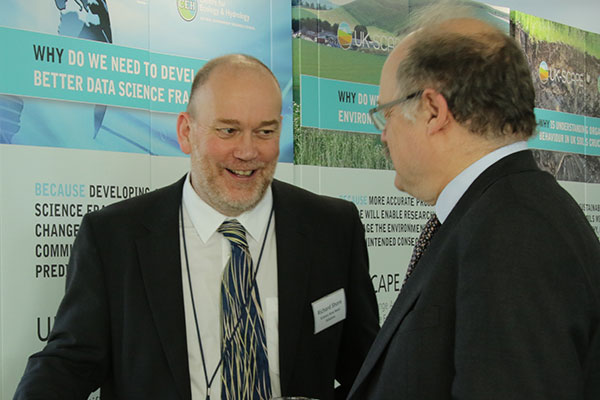
Professor Richard Shore

Professor Richard Shore

Section Head and Head of Site, CEH at Lancaster

Centre for Ecology & Hydrology
Lancaster Environment Centre, Library Avenue
Bailrigg, Lancaster, LA1 4AP
Telephone: +44(0)1524 595867
Fax: + 44 (0) 1524 61536
E-mail: Professor Richard Shore

Role

I head a section of some 40 staff and students whose research principally focuses on the fate, behaviour and effects of chemicals in the environment. My own research centres on studying the exposure and effects of and pollutants, biocides and pesticides in wild birds and mammals (see below). I am also the current Head of Site at CEH Lancaster.

Research Interests

Chemicals are vital for health and economic development but can also have adverse impacts on wildlife and people. For economic development to be sustainable, it is essential that the risks associated with the manufacture, use and disposal of chemicals can be assessed scientifically and objectively. This requires scientific data and understanding of what contaminants are present in the environment and what effects they may have. My research focuses on:

  • monitoring the contamination of wild mammals and birds by pollutants and pesticides.
  • identifying new chemical threats to wildlife.
  • understanding how and why contamination varies geographically and over time.
  • understanding what drives the transfer of chemicals along food-chains.
  • investigating, assessing and predicting the impacts contamination may have.

The results from this research help identify chemical risks, develop appropriate assessment and mitigation strategies, and guide the formulation of effective policies to protect environmental and human health.
More details about our long-term, large scale monitoring of contaminants in birds can be found on CEH's Predatory Bird Monitoring Scheme (PBMS) website.


Brief Curriculum Vitae

  • Researcher in vertebrate ecotoxicology; author/co-author of >175 papers, book chapters, articles and contract reports (includes >80 ISI journal papers).
  • 2008 onwards: Head of Site, CEH at Lancaster.
  • 2007 onwards: Section Head, CEH at Lancaster.
  • 2006-2011: Honorary Professor, Queen’s University, Belfast.
  • 2002 onwards: Member of the editorial boards of Environmental Pollution and Environmental Toxicology & Chemistry.
  • 2005-08: Member of the Society of Environmental Toxicology and Chemistry, the British Ecological Society and the Mammal Society.
  • External lecturer on MSc courses for the Universities of Birmingham (2002-current) and London (2005-current).
  • 2002-03: Chairman of ACP Environmental Panel’s Rodenticide Risk Assessment Technical Working Group.
  • 2002-07: Head, Ecological Risk Section, CEH Monks Wood.
  • 2000 onwards: Member of the Environmental Panel of the Advisory Committee on Pesticide (ACP).
  • 2000-2002: Head of Vertebrate Ecology & Toxicology Group, CEH at Monks Wood.
  • 1999-2004: Conference Secretary, The Mammal Society.
  • 1995-1998: Council Member, The Mammal Society.
  • 1995-2000 Head, Analytical Chemistry Unit, Monks Wood.
  • 1988-95 Pollution & Ecotoxicology Section, ITE Monks Wood.
  • 1984-88 PhD “Effects of variation in environmental calcium availability on wild rodent populations”.
  • 1986 Co-leader of the University of Manchester Shira Plateau Expedition, Mt. Kilimanjaro, Tanzania.
  • 1981-84 BSc (Hons) Zoology, University of Bristol.
Selected Recent Publications

Pereira, M.G., Walker, L.A., Best, J. & Shore, R.F. in press. Long-term trends in mercury and PCB congener concentrations in gannet (Morus bassanus) eggs in Britain. Environmental Pollution.

Jagannath, A., Shore, R.F., Walker, L.A., Ferns, P.R. & Gosler, A.G. 2008. Eggshell pigmentation indicates pesticide contamination. Journal of Applied Ecology 45, 133-140.

Walker, L.A, Turk, A., Long, S.M., Wienburg, C.L. , Best, J., & Shore, R.F. 2008. Second generation anticoagulant rodenticides in tawny owls (Strix aluco) from Great Britain. The Science of the Total Environment 392 93-98.

Shore, R.F. & Hare, E. J. 2008. Bank vole. pp. 88-99 in Mammals of the British Isles: handbook 4th edition. (eds S. Harris & D.W. Yalden)., The Mammal Society, London.

Griffin, J.L & Shore, R.F. 2007. Applications of metabonomics within environmental toxicology. in The Handbook of Metabonomics and Metabolomics, (eds J.C. Lindon, J.K. Nicholson & E. Holmes). Elsevier Press, pp. 517-532.

Pain, D.J., Carter, I., Sainsbury, A., Shore, R.F., Eden, P, Taggart, M., Stavrianakis, K., Walker, L.A, Meharg, A. & Raab, A. 2007. Lead contamination and associated disease in reintroduced red kites Milvus milvus in England. The Science of the Total Environment 376 116-127.

Knopper, L.D., Mineau, P., Shore, R.F. & Walker, L.A. 2007. Bone density and breaking strength in UK raptors exposed to second generation anticoagulant rodenticides. Bulletin of Environmental Contamination & Toxicology 78 249-251.

Walker, L.A, Simpson, VR, Rockett, L., Wienburg, C.L. & Shore, R.F. 2007. Heavy metal contamination in bats in Britain. Environmental Pollution 148 483-490.

Martinez-Lopez, E., Maria-Mojica, P., Martinez, J.E., Calvo, J.F., Wright, J., Shore, R.F., Romero, D. & Garcia-Fernandez, A.J. 2007. Organochlorine residues in booted eagle (Hieraaetus pennatus) and goshawk (Accipiter gentilis) eggs from southeastern Spain. Environmental Toxicology and Chemistry 26 2373-2378.

Jones, O.A.H., Walker, L.A., Nicholson, J.K., Shore, R.F. & Griffin, J.L. 2007. Cellular acidosis in rodents exposed to cadmium is caused by adaptation of the tissue rather than an early effect of toxicity. Comparative Biochemistry & Physiology D—Genomics & Proteomics 2 316-321.

Shore, R.F., Malcolm, H.M., McLennan, D., Turk, A., Walker, L.A., Wienburg, C.L. & Burn A. J. 2006. Did Foot and Mouth Disease control operations affect rodenticide exposure in raptors? Journal of Wildlife Management 70 588-593.

Long, S.M., Dawson, A. & Shore, R.F. 2006. A comparison of the effects of single and repeated exposure to an organophosphate insecticide on acetylcholinesterase activity in mammals. Environmental Toxicology & Chemistry 25 1857-1863.

Bennett, R.S., Dewhurst, I.C., Fairbrother, A., Hart, A.D.M., Hooper, M.J., Leopold, A., Mineau, P., Mortensen, S.R., Shore, R.F. & Springer, T.A. 2005. A new interpretation of avian and mammalian reproduction toxicity test data in ecological risk assessment. Ecotoxicology 14 801-815.
Shore, R.F., et al.,2005. Case Study Part 1: How to calculate appropriate deterministic long-term Toxicity to Exposure Ratios (TERs) for birds and mammals. Ecotoxicology 14 877-893.

Roelofs, W., Crocker, D.R., Shore, R.F., et al., 2005. Case Study Part 2: Probabilistic modelling of long-term effects of pesticides on individual breeding success in birds and mammals. Ecotoxicology 14 895-923.

Shore, R.F., Meek, W.R., Sparks, T.H., Pywell, R.F. & Nowakowski, M. 2005. Will Environmental Stewardship enhance small mammal abundance on intensively managed farmland? Mammal Review 35 277-284.

Erry, B.V., Macnair, M.R., Meharg, A.A., and Shore, R.F. 2005. The distribution of arsenic in the body tissues of wood mice and bank voles. Archives of Environmental Contamination & Toxicology 49 569-576.

Flowerdew, J.R., Shore R.F., Poulton, S.M.C., & Sparks, T.H. 2004. Live trapping to monitor small mammals in Britain. Mammal Review 34 31-50.

Wienburg, C.L. & Shore, R.F. 2004. Factors influencing PCB concentrations in sparrowhawks (Accipiter nisus), kestrels (Falco tinnunculus) and herons (Ardea cinerea) in Britain. Environmental Pollution 132 41-50.

Shore, R.F., Birks, J.D.S., Afsar, A., Wienburg, C.L. & Kitchener, A.C. 2003. Spatial and temporal analysis of second-generation rodenticide residues in polecats (Mustela putorius) from throughout their range in Britain, 1992-1999. Environmental Pollution 122 183-193.

López Alonso, M., Benedito, J.L., Miranda, M., Fernández, J.A., Castillo, C., Hernández , J. and Shore, R.F. 2003. Large-scale spatial variation in mercury concentrations in cattle in NW Spain. Environmental Pollution 125 173-181.
Shore, R.F. & Rattner, B.A. (eds) 2001. Ecotoxicology of Wild Mammals. John Wiley & Sons, London, pp. 730.