Sand Dune Research

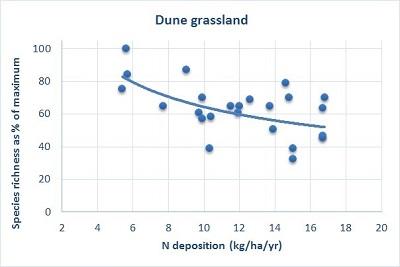
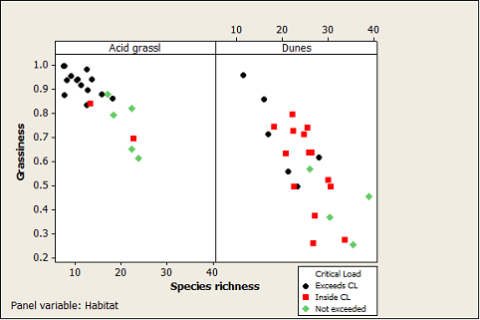
Nitrogen (N) deposition is thought to be a major contributor to over-stabilisation and species decline in UK dune systems. Our research looks at the impacts of nitrogen on plant communities and on development of the underlying skeletal soils through a wide range of approaches:

UK-wide field survey detecting signals of nitrogen deposition in soils, plant communities and groundwater of dune systems. This work was instrumental in setting the critical load (damage threshold) for sand dunes of 10 – 20 kg N ha-1 yr-1, (Jones et al., 2002a; Jones et al., 2002b; Jones et al., 2004).

  • Measuring N budgets to calculate retention of N in four dune habitats: mobile dunes, grazed fixed dune grassland, rank grassland, and dune slacks, (Jones et al., 2005).
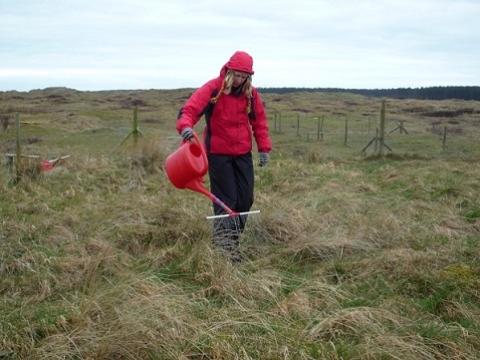
  • Field-scale manipulation experiments looking at nitrogen addition and grazing have shown that even small additions of N affect vegetation and soil, and that grazing does not prevent this change (Plassmann, 2006)
  • Modelling of rare species’ soil requirements and the impact of increasing N deposition. Responses are species-specific. Equisetum variegatum is sensitive to soil N contents, while the liverwort Petalophyllum ralfsii may be more sensitive to indirect effects mediated by plant competition. Centaurium littorale and Parnassia palustris are less sensitive (Emmett, 2007).
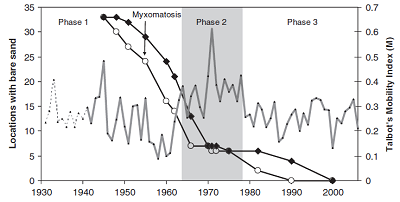
  • Historical reconstruction using a soil chronosequence shows rapid rates of soil development over the last 60 years. Climate has a dominant effect, but N deposition may also play a part (Jones et al., 2007).
  • Testing nitrogen effects on ‘facilitation’ theory. Legumes facilitate vegetation succession but N deposition may alter this by reducing N fixation. A new manipulation experiment is looking at the combined effects of legumes and N deposition on plant community and soil development.

References

Emmett, B.A. (Ed.), 2007. Effects of Eutrophication and Acidification on Terrestrial Ecosystems. Final report to UK Department of Environment, Farming and Rural Affairs. CEH Bangor.

Jones, M.L.M., Hayes, F., Brittain, S.A., Haria, S., Williams, P.D., Ashenden, T.W., Norris, D.A., Reynolds, B., 2002a. Changing nutrient budgets of sand dunes: Consequences for the nature conservation interest and dune management.  2. Field survey. Contract Report September 2002.  CCW Contract No: FC 73-01-347.  CEH Project No: C01919., Centre for Ecology & Hydrology, Bangor.

Jones, M.L.M., Reynolds, B., Stevens, P.A., Norris, D., Emmett, B.A., 2002b. Changing nutrient budgets of sand dunes: Consequences for the nature conservation interest and dune management.  1. A review. Contract  Report March 2002.  CCW Contract No: FC 73-01-347.  CEH Project No: C01919., Centre for Ecology & Hydrology, Bangor.

Jones, M.L.M., Wallace, H.L., Norris, D., Brittain, S.A., Haria, S., Jones, R.E., Rhind, P.M., Reynolds, B.R., Emmett, B.A., 2004. Changes in vegetation and soil characteristics in coastal sand dunes along a gradient of atmospheric nitrogen deposition. Plant Biology 6 (5), 598-605.

Jones, M.L.M., Pilkington, M.G., Healey, M., Norris, D.A., Brittain, S.A., Tang, Y.S., Reynolds, B., 2005. Determining a nitrogen budget for Merthyr Mawr sand dune system. Final report for Countryside Council for Wales. CEH Project No: C02352NEW, CCW Contract No: FC 72-02-59. May 2005.

Jones, M.L.M., Sowerby, A., Wallace, H.A., 2007. Better Understanding of Soil Resources - Dune Stabilisation and Rates of Soil Development on Welsh Dune Systems. Final Report to Countryside Council for Wales. March 2007., CEH Bangor.

Plassmann, K., 2006. Effects of grazing and nitrogen deposition on sand dune systems. PhD Thesis, University of Wales, Bangor.