Professional summary
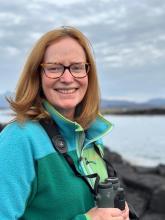
Lori is a Senior Scientist in the Aquatic Ecosystems Group at UKCEH, specialising in freshwater molecular ecology. Her research focuses on developing environmental DNA (eDNA) tools for biodiversity monitoring in freshwater systems, with particular interest in the impacts of environmental stressors and ecological restoration. She is committed to advancing DNA-based biodiversity monitoring and aligning research with policy needs.
Lori co-led research on Windermere that trialled eDNA metabarcoding for monitoring of lake fish communities. This became the first eDNA metabarcoding tool to be adopted for routine monitoring by UK government agencies. The approach was later used to identify spawning patterns of Windermere’s most iconic fish species, Arctic charr. Lori continues to study Arctic charr populations and the threats they face, including climate change, pollution, and invasive species such as ruffe.
A major focus of Lori’s research is the detection, monitoring, and management of invasive species using eDNA, as well as their impacts on biodiversity. She also contributes to horizon scanning initiatives to inform prevention strategies across the UK and Overseas Territories. Lori is also interested in the ecological impacts of rewilding, including beaver reintroductions, river restoration, and habitat regeneration, working with regulators and NGOs to provide evidence for decision making.
Lori has been involved in the UKEOF UKDNA Working Group since its inception in 2014 and became UKEOF Secretariat Lead in January 2025.
She obtained her PhD from the University of East Anglia in 2000, and worked at the Universities of Uppsala, Lausanne, Cambridge and Hull before joining UKCEH in 2025.
Lawson Handley, L., Read, D. S., Winfield, I. J., Kimbell, H., Johnson, H., Li, J., Hahn, C., Blackman, R., Wilcox, R., Donnelly, R., Szitenberg, A., & Hänfling, B. (2019). Temporal and spatial variation in distribution of fish environmental DNA in England’s largest lake. Environmental DNA, 1(1), 26–39. https://doi.org/10.1002/edn3.5
Li, J., Hatton‐Ellis, T. W., Lawson Handley, L., Kimbell, H. S., Benucci, M., Peirson, G., & Hänfling, B. (2019). Ground‐truthing of a fish‐based environmental DNA metabarcoding method for assessing the quality of lakes. The Journal of Applied Ecology, 56(5), 1232–1244. https://doi.org/10.1111/1365-2664.13352
Li, J., Lawson Handley, L. J., Harper, L. R., Brys, R., Watson, H. V., Di Muri, C., Zhang, X., & Hänfling, B. (2019). Limited dispersion and quick degradation of environmental DNA in fish ponds inferred by metabarcoding. Environmental DNA, 1(3), 238–250. https://doi.org/10.1002/edn3.24
Harper, L. R., Lawson Handley, L., Carpenter, A. I., Ghazali, M., Di Muri, C., Macgregor, C. J., Logan, T. W., Law, A., Breithaupt, T., Read, D. S., McDevitt, A. D., & Hänfling, B. (2019). Environmental DNA (eDNA) metabarcoding of pond water as a tool to survey conservation and management priority mammals. Biological Conservation, 238, 108225. https://doi.org/10.1016/j.biocon.2019.108225
Harper, L. R., Lawson Handley, L., Hahn, C., Boonham, N., Rees, H. C., Lewis, E., Adams, I. P., Brotherton, P., Phillips, S., & Hänfling, B. (2019). Generating and testing ecological hypotheses at the pondscape with environmental DNA metabarcoding: A case study on a threatened amphibian. Environmental DNA, 60, 255. https://doi.org/10.1002/edn3.57
Blackman, R. C., Ling, K. K. S., Harper, L. R., Shum, P., Hänfling, B., & Lawson-Handley, L. (2020). Targeted and passive environmental DNA approaches outperform established methods for detection of quagga mussels, Dreissena rostriformis bugensis in flowing water. Ecology and Evolution, 10(23), 13248–13259. https://doi.org/10.1002/ece3.6921